English
 русский
 Español
 عربى
عربى
A gearbox shaft is pushed sideways by the teeth of helical gears, and it is also pushed along its own centreline by the reaction force that helical gear meshing produces. A pump impeller pushes its shaft backward against the motor end every time the machine starts. A fan blade creates a constant aerodynamic thrust that loads the bearing at the non-drive end. In every one of these systems, an axial bearing is what keeps the shaft from moving along its axis.
Axial bearings, also called thrust bearings, are components designed to accept forces acting parallel to the shaft. The most common specification mistake is treating the axial load as a secondary consideration. When no dedicated axial bearing is provided, the load is absorbed by seals, shoulders, and end covers, which wear quickly and fail unpredictably.
Bottom line
Give every axial load a dedicated bearing surface, verify that the material can handle the contact pressure and sliding speed, and confirm that lubrication, whether external or embedded in the bearing compound, will last the full service interval.
Content
What an Axial Bearing Actually Does
An axial bearing supports a load that acts parallel to the shaft centreline, while a radial bearing supports a load acting perpendicular to that centreline. Most machines create both types of load at the same time, so the bearing arrangement usually includes one radial bearing and one axial bearing, or a combined bearing that handles both directions.
Axial forces are not rare. They appear wherever helical gears transmit torque, where pump impellers develop hydraulic pressure, where fans move air, where screw conveyors compress material, and where linear actuators push against rotating shafts. Ignoring any of these sources produces a failure that is called a bearing problem but is really a design problem.
The bearing industry groups axial bearings into two families. Rolling-element thrust bearings transfer the load through balls or rollers and suit higher speeds with moderate loads. Sliding thrust bearings transfer the load through a thin film of lubricant or through the solid lubricants embedded in the material, and suit compact spaces, shock loads, and maintenance-free service.
Three Common Families of Axial Bearings
Thrust ball bearings carry light to moderate axial loads and run at high speeds. Their small contact area keeps friction low, but they are not a good match for vibration, shock, or continuous heavy thrust.
Thrust roller bearings take over where loads grow. Cylindrical roller thrust bearings use line contact for high stiffness. Spherical roller thrust bearings add self-alignment, which becomes necessary when shaft deflection or housing misalignment cannot be avoided.
Thrust washers are the most widely used axial bearing form in compact machinery. A thrust washer is a flat ring that sits between a rotating shaft shoulder and a stationary face, providing a controlled sliding interface with a predictable friction level. When it is made from a wear-resistant compound with embedded solid lubricants, a single thrust washer can replace a much larger rolling-element assembly at lower cost. The wear-resistant thrust washer used in steering systems and pumps is a typical example of this construction.
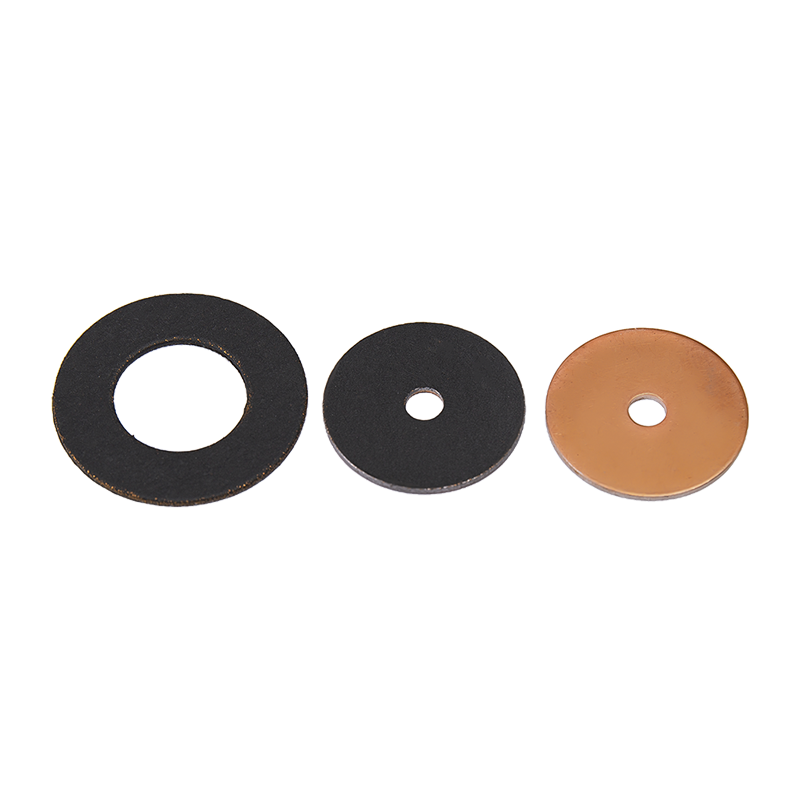 1WC Wear-resistant thrust washer Suppliers, Company - Zhejiang Huazhou TechnologHuazhou is 1WC Wear-resistant thrust washer Suppliers and Company in China, Wholesale 1WC Wear-resistant thrust washer, The 1WC Wear-Resi...View Product →
For a closer look at washer construction, the thrust washer selection guide explains the practical differences between plain, flanged, lined, and sealed versions.
Axial Bearing Options at a Glance
Before choosing a family, compare how each option performs on five basic criteria: load capacity, speed capability, friction, lubrication, and installation space.
The table shows why sliding thrust washers appear in so many products: they are compact, many grades are self-lubricating, and material selection can push them into heavy-load territory.
Material Choice Sets the Real Load Limit
For sliding axial bearings, the material of the washer or the plate decides the real performance envelope. The geometry matters, but the contact pressure and the pressure-velocity (PV) value that the material can withstand are what determine service life.
Bimetallic graphite copper and tin bronze sit at the high end, while steel-based grades with inorganic fillers follow closely. Porous sintered copper and engineering plastics cover lighter duty cycles. One important distinction is whether the bearing is self-lubricating or boundary-lubricated. Self-lubricating grades carry solid lubricants inside the material and need no external oil supply; boundary-lubricated grades rely on a thin oil layer replenished at defined intervals. This difference changes the maintenance schedule significantly. The black thrust washer with a POM-lead filler is designed for the boundary-lubricated end of this spectrum. The article on self-lubricating vs. boundary-lubricated designs explains both approaches in practical detail.
 2XWC Black thrust washer Suppliers, Company - Zhejiang Huazhou Technology Co., LHuazhou is 2XWC Black thrust washer Suppliers and Company in China, Wholesale 2XWC Black thrust washer, 2XWC black thrust washers are mad...View Product →
Industry Application Distribution
Axial sliding bearings appear in nearly every mechanical sector, but some industries consume them more consistently than others.
Automotive applications take the largest share because thrust washers are standard in steering columns, transmissions, oil pumps, and adjustment mechanisms. Industrial gearboxes and powertrain drives follow, with pumps, compressors, and valves not far behind, because hydraulic thrust is a daily operating condition there. Material handling, construction, agriculture, and marine machinery complete the picture with smaller but steady volumes.
Step-by-Step Axial Bearing Selection
The fastest path to a reliable axial bearing specification is a six-step workflow.
1. Define the axial load
Calculate both the steady-state thrust and any transient peaks. A bearing selected only for the steady-state load will fail on the first shock event.
2. Establish sliding speed
Multiply the contact pressure by the sliding velocity to obtain the PV value, and screen out materials that cannot handle it.
3. Decide lubrication strategy
For dry or greased-once service, choose a self-lubricating grade. For oil-fed systems, a wider and more economical range of materials becomes available.
4. Check environment
High temperatures require graphite or inorganic fillers. Aggressive media demand stainless steel or engineering plastic bases.
5. Verify mounting details
The shaft shoulder must be square, the housing bore must have the correct depth, and the counterface hardness must resist scoring.
6. Plan wear life
Wear in sliding axial bearings is approximately proportional to the PV value, so estimate cumulative running hours and set an inspection interval.
Each of these steps takes about half a day of engineering work. Skipping one can take the whole machine out of service for a week.
Maintenance and Compliance Checks
Once an axial bearing is in service, maintenance must match the bearing family and the material. Check the axial clearance with a dial indicator at every major inspection. A wear limit of 0.2 to 0.5 mm is typical for compact thrust washers, depending on the original clearance and the load level.
For self-lubricating thrust washers, do not add grease unless the design includes grease channels. Extra grease traps dust and turns into an abrasive paste. For oil-fed designs, follow the exact replenishment interval. The oil-hole thrust washer is produced with a defined lubrication path so that a scheduled oil dose reaches the sliding interface efficiently.
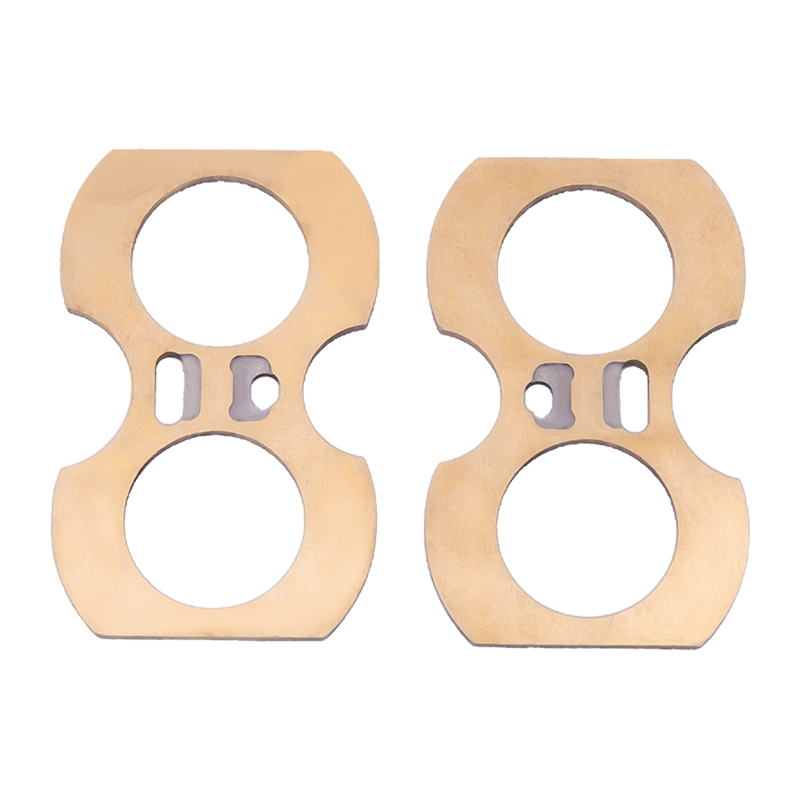 800WC Lubricating oil hole thrust washer Suppliers, Company - Zhejiang Huazhou THuazhou is 800WC Lubricating oil hole thrust washer Suppliers and Company in China, Wholesale 800WC Lubricating oil hole thrust washer,View Product →
Inspect the mating shaft shoulder and housing face each time the bearing is replaced, because a scored counterface will destroy a new thrust washer within hours. Documentation matters more than many buyers expect. Automotive customers commonly ask for PPAP documents and IATF 16949 certification. Shipments to the European Union require RoHS and REACH compliance statements. Keep material certificates and dimensional inspection reports in the same file as the purchase order.