English
 русский
 Español
 عربى
عربى
A maintenance supervisor at an automotive stamping plant replaced a grease-lubricated bronze bushing on a press linkage every six weeks. The bushing was not defective; the lubrication interval could never be met reliably in that tight, dirty location. Switching to a steel-backed self-lubricating bushing with the same bore size and load rating eliminated the recurring failure. A good bearing bushing selection does exactly this: it matches the component to the real operating environment.
The takeaway: a bearing bushing is a replaceable cylindrical plain bearing that supports a rotating or sliding shaft inside a housing. Most premature failures are not material defects; they are mismatches between the bushing's lubrication strategy and the load, speed, or contamination present in the application.
Content
What Is a Bearing Bushing?
A bearing bushing, also called a sleeve bearing or plain bearing, is a single-component cylinder pressed or slip-fitted into a bore. The shaft rotates or slides inside the bushing bore while the bushing carries three responsibilities: reducing friction, absorbing shock, and protecting the relatively expensive housing from wear. When the bushing eventually wears, you replace the bushing, not the housing or the shaft.
Is a bushing the same as a bearing? In the general sense, yes. A bushing is a bearing because it guides and supports a moving machine element while limiting friction. The practical distinction is the type of contact. Rolling-element bearings separate the shaft from the housing with balls or rollers. A bushing uses a continuous sliding surface. That one difference drives every subsequent engineering decision.
| Consideration | Bearing bushing (plain) | Rolling-element bearing |
|---|---|---|
| Contact type | Continuous sliding surface | Balls or rollers |
| Breakaway torque | Higher unless self-lubricating | Very low |
| Shock damping | Excellent | Moderate |
| Load capacity | Good at low to moderate speed | Better at high speed |
| Lubrication | Grease-packed, oil-impregnated, or maintenance-free | Clean oil required |
| Cost and fit | Low; simple press fit | Higher; precision fitting required |
For oscillating motion, intermittent rotation, or low to moderate shaft speeds, a bushing is usually the cheaper, lighter, and more compact solution. It also tolerates misalignment and edge loading better than rolling elements. Above roughly 50,000 DN (bore diameter in millimetres multiplied by shaft speed in rpm), rolling-element bearings tend to become the practical choice.
Material and Construction Families
The material and construction of a bushing determine its allowable load, speed limit, temperature range, and lubrication needs. Five families cover most industrial and automotive assignments.
Self-lubricating steel-backed bushings
A steel backing carries the structural load, a sintered bronze interlayer retains a PTFE and inorganic filler, and the liner transfers a dry film onto the shaft. These bushings run with no external oil or grease and hold a friction coefficient of roughly 0.05 to 0.10. They are the default for automotive shock absorbers, suspension pivots, and pump linkages where maintenance access is poor.
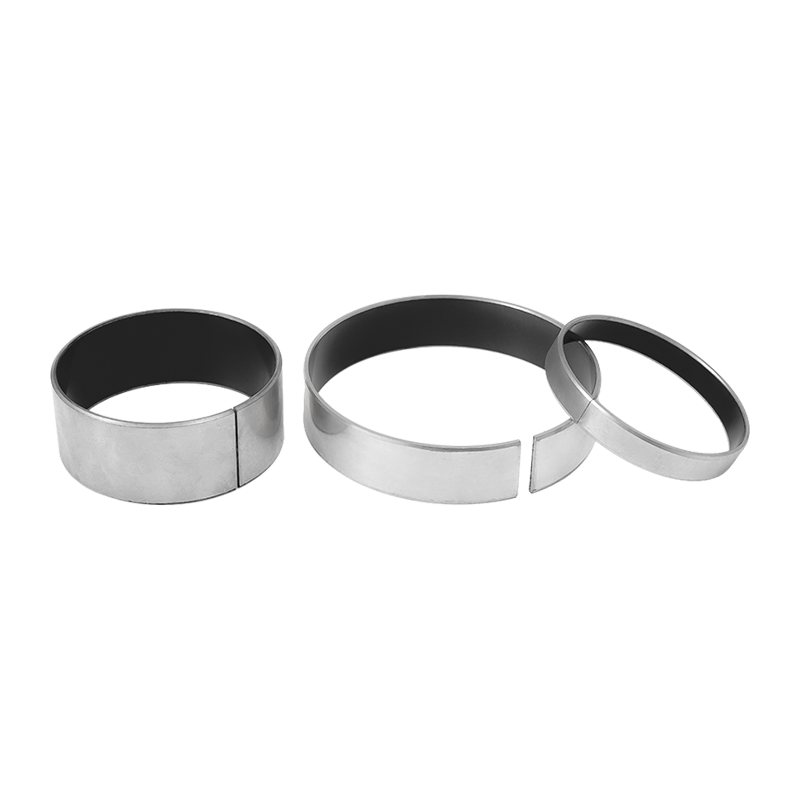 Steel-Based Self-Lubricating Bearing with PTFE LinerThis dry-running bushing combines a steel backing with sintered bronze and a PTFE compound, offering maintenance-free operation for pivots and linkages where regular lubrication is impractical.View Product →
Bronze monometallic bushings
Tin bronze and brass bushings with oil grooves remain the classic solution for oscillating, heavily loaded shafts where a maintenance schedule already exists. They tolerate dirt and shock well but require re-lubrication at regular intervals. When the grease interval is missed, the failure arrives quickly.
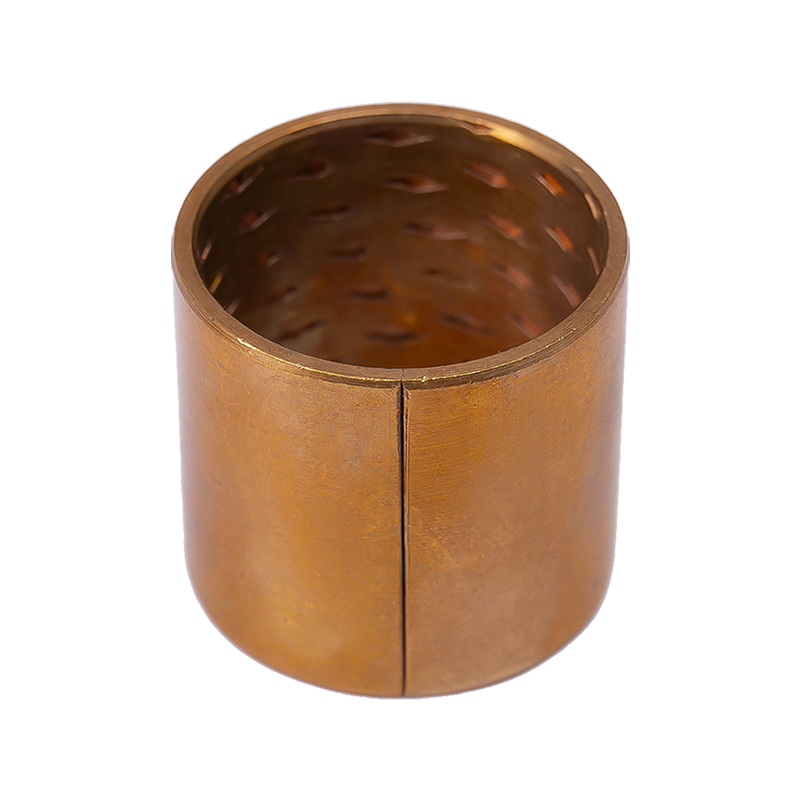 Tin Bronze Oil Groove Monometallic BushingA thin-walled tin bronze bushing with oil grooves that stores grease for extended intervals, suited for medium-to-high loads and oscillating shafts in demanding industrial environments.View Product →
Graphite-plugged copper bushings
Solid graphite plugs are pressed into a copper alloy matrix. As the shaft rotates, the graphite forms a dry film on the mating surface, creating a low-friction interface without liquid lubricant. That makes graphite-copper bushings valuable in high-temperature furnaces, dusty cement plants, and food lines where oil contamination is unacceptable.
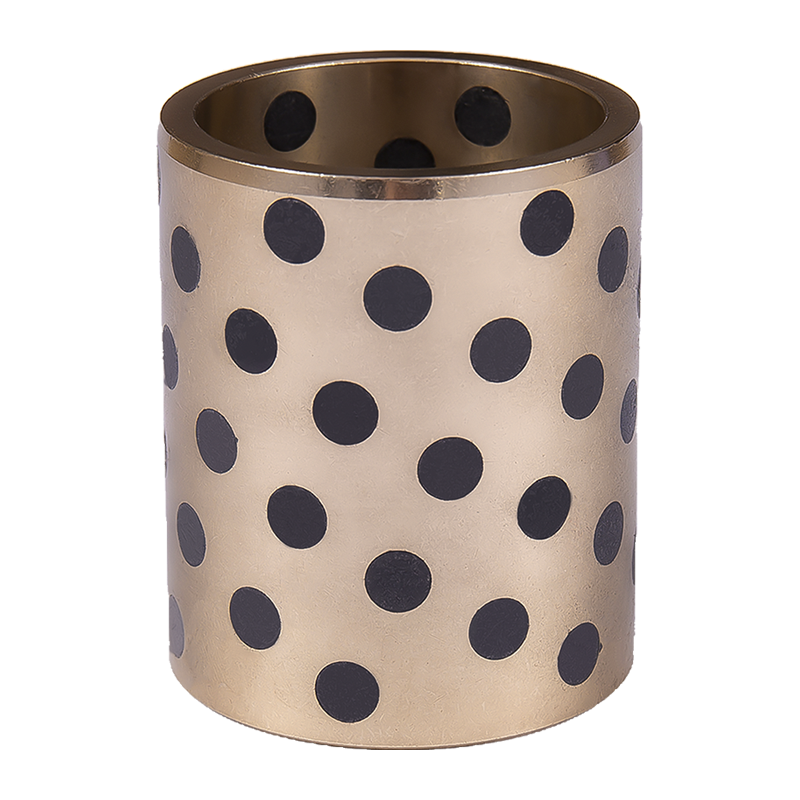 Wear-Resistant Graphite Copper BushingThis bronze bushing with solid graphite plugs provides dry lubrication for high-load, intermittent or oscillating motion, ideal for high-temperature, dusty, or contamination-sensitive applications.View Product →
Boundary-lubricated and engineering plastic bushings
Boundary-lubricated bushings use a porous sintered bronze layer impregnated with POM polymer that acts as a built-in grease reserve for intermittent motion at moderate loads. Engineering plastic bushings suit light loads, wet environments, and appliances where quiet running and corrosion resistance matter more than load capacity. For a closer look at how the two lubrication strategies behave in practice, see our comparison of self-lubricating versus boundary-lubricated bearings.
Selection Criteria That Matter Most
The single most useful screening number for a bearing bushing is the PV value: pressure in megapascals multiplied by surface velocity in metres per second. PV correlates with the heat generated at the contact interface. Every reputable manufacturer publishes a limiting PV curve; if the duty cycle stays below roughly 70 percent of that limit, the bushing will usually perform. If the PV limit is exceeded for sustained periods, the liner degrades even when the static load alone looks acceptable.
Friction coefficients of common bushing families provide a quick comparison of running behaviour:
Steel-based self-lubricating
(0.05-0.10)
Boundary-lubricated POM
(0.08-0.12)
Graphite copper
(0.10-0.18)
Bronze with oil film
(0.08-0.15)
Engineering plastic dry
(0.12-0.20)
Bar height is proportional to typical friction coefficient; lower means less friction and less heat.
Four operating conditions deserve attention beyond PV: shaft hardness and finish, temperature, motion type, and mounting style. A hardened shaft of 45 HRC minimum with a finish near Ra 0.4 to 0.8 micrometres can reduce bushing wear by a factor of two or three. PTFE-based self-lubricating liners typically operate from -40°C to +280°C, while POM-filled and plastic grades have lower limits. Unidirectional rotation, oscillation, and linear sliding each create different wear patterns. Straight sleeves suit radial load, flanged bushings carry light axial location, and thrust washers handle axial thrust.
For a step-by-step procedure covering load, speed and material, our DX bushing selection guide provides practical starting values and calculation methods.
Where Bearing Bushings Are Used Most
Self-lubricating and boundary-lubricated bushings appear in more everyday products than most engineers realise. Field usage across industry segments typically looks like this:
- Automotive: suspension, steering, shock absorbers (35%)
- Industrial machinery: conveyors, pumps, packaging lines (30%)
- Construction and agriculture: pivot joints, steering linkages (15%)
- Home appliances: washing machines, mixers (10%)
- Other: furniture, medical equipment, leisure (10%)
The pattern is consistent: a bushing is chosen where maintenance access is limited, contamination is present, or a low-cost press-fit component can replace a more complex rolling-element assembly.
Selection Workflow and Return on Investment
A disciplined selection process takes less than an hour and prevents years of avoidable downtime. This sequence works for new designs and for repeat-failure replacements alike.
1. Define the duty cycle
Record radial load, shaft speed or oscillation angle, temperature, and contamination level.
2. Calculate PV
Multiply specific pressure by surface velocity and compare with the material limit.
3. Choose construction
Pick a straight sleeve, flanged bushing, or thrust washer according to the load direction.
4. Specify the shaft
Define minimum hardness, surface finish, and recommended clearance.
5. Validate with a pilot run
Measure initial bore, temperature rise, and noise; recheck bore wear after the first service interval.
The return is measurable. A packaging plant with sixty grease points can spend fifteen minutes per point per week on re-lubrication, or roughly 780 hours of labour per year across one shift. Replacing those points with maintenance-free bushings eliminates that work, improves safety by removing awkward access tasks, and removes the most common root cause of failure: the missed grease interval.
Maintenance and Compliance Considerations
Even a maintenance-free bushing should be inspected. During planned downtime, measure the inside diameter at the centre of the loaded zone and compare it with the original bore. When the bore grows beyond the supplier's recommended limit, typically three to five percent of the wall thickness for steel-backed self-lubricating types, replace the bushing. Also inspect the shaft for scoring and discolouration; a blued shaft indicates sustained overheating at the interface.
On the procurement side, request material certificates, batch dimensional inspection reports, and declarations of restricted substances such as RoHS and REACH for European shipments. A manufacturer operating to ISO 9001 will usually provide these documents without delay. These records are the practical evidence that the bushing you specify today will match the bushing you receive six months from now.