English
 русский
 Español
 عربى

A quarry maintenance planner replaces the same 40 mm pivot bushing every eleven weeks. The part is machined from free-cutting brass because it machines fast and sits on the shelf looking identical to the original. The pulled parts come out smeared and gummy, with a polished crescent on the loaded side, which is the signature of a lubricating film collapsing rather than simple abrasion. Moving that joint to a tin bronze with a diamond-pattern oil groove carried the same position past nine months on the next two rebuilds.
That swap is the whole argument in miniature. Bronze is a bearing material; brass is a machining material that happens to be round.
Bottom line: specify bronze for bushings. For a lubricated radial or thrust joint at moderate speed, a cast tin bronze such as C93200 (SAE 660) with an oil groove and an NLGI 2 EP grease covers most industrial cases. For dry, starved or hot duty, step up to bronze with solid graphite plugs or a bronze-backed composite. Keep brass for light, low-consequence pivots where nothing but machinability matters.
Content
- 1 What Bronze Gives a Bushing That Brass Does Not
- 2 Brass vs Bronze: A Comparison You Can Take to a Quote Review
- 3 Lubrication Regime Sets the Real Service Life
- 4 Matching the Bronze Grade to the Duty
- 5 Where Bronze Bushings Actually Get Used
- 6 From Drawing to First Article: A Sourcing Sequence
- 7 Maintenance and Compliance Notes
What Bronze Gives a Bushing That Brass Does Not
Bronze is a copper-tin alloy, usually with lead or zinc added for castability and machining. The tin-rich phase is harder than the matrix around it, so the structure behaves like a fine dispersion of hard islands in a ductile copper base. Under load the softer phase yields first, letting the hard phase carry pressure while the surface conforms to shaft misalignment. That mechanism is what a brass of roughly 61 percent copper, 36 percent zinc and 3 percent lead cannot reproduce.
Load capacity
Cast tin bronze runs to about 240 MPa tensile and roughly 70 HB, enough to hold steady radial pressure where brass cold-flows and pounds out of the housing.
Conformability
The soft matrix laps minor misalignment and edge loading during running-in, so contact pressure spreads instead of concentrating on one strip of the bore.
Heat path
Copper alloys pull frictional heat away from the contact patch, which keeps the film cooler than a steel-backed or plastic alternative at the same PV.
Corrosion behaviour
Bronze resists dezincification because there is little zinc to lose. Brass in damp or wash-down service can lose zinc selectively and turn porous at the bore.
Brass vs Bronze: A Comparison You Can Take to a Quote Review
Purchasing usually sees only piece price and lead time. The comparison below is the version worth pinning next to the quotation, because the cheapest part becomes the most expensive one when it is replaced four times a year.
Brass wins on tensile strength and machining speed. Bronze wins on every property that decides whether a bushing survives a thousand hours of radial load.
Lubrication Regime Sets the Real Service Life
Bronze bushings are not self-lubricating by nature. Cast and wrapped bronze need an external film, and that film decides the outcome far more than the alloy does. A lithium-complex NLGI 2 grease with EP additives suits slow, heavy joints; a mineral oil suits higher speed where grease would churn and heat.
Relative life index for one 40 mm bushing geometry, normalized to greased-with-groove at 100. Planning figures, not a performance guarantee.
Two details move that index more than grade choice. A groove deeper than roughly 30 percent of wall thickness removes load-bearing section, so deep grooves buy lubrication at the cost of pressure capacity. Starvation also announces itself as heat rather than noise, which makes a 10 degree rise on a greased joint worth investigating before it becomes a scored shaft.
Where re-lubrication is simply not possible, a bronze with graphite plugs keeps a solid film in the contact and tolerates elevated temperature without a grease channel.
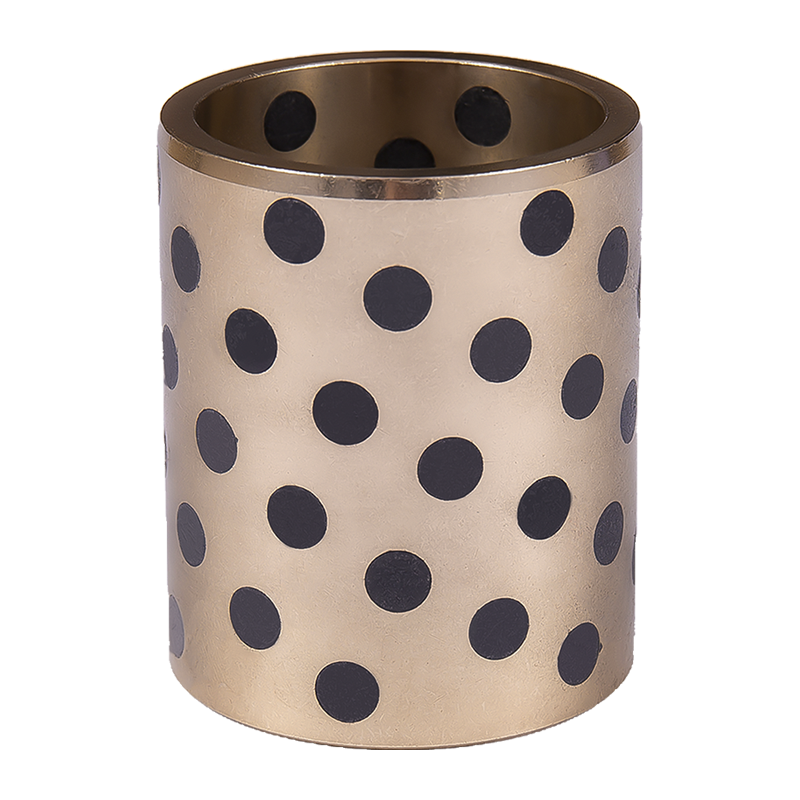 HZ-JDB Graphite Copper Bushings for Maintenance-Free ApplicationsGraphite-plug bronze bushings suit high-load, intermittent or oscillating motion where relubrication is impractical and elevated temperatures must be tolerated.View Product →
For grease selection, relubrication intervals and groove design, the bronze bushing lubrication guide covers the practical detail behind these numbers.
Matching the Bronze Grade to the Duty
Once bronze is settled, the remaining question is which bronze. The grade families below cover the bulk of industrial demand.
- Cast or centrifugally cast tin bronze (C93200 / SAE 660): the general-purpose choice for bushings, washers and linkage joints that receive grease.
- Leaded gunmetal and high-lead bronze: better conformability and emergency running when the film is interrupted, at the cost of lead declarations.
- High-tin aluminium alloys: higher fatigue resistance for connecting rod eyes and heavily loaded pivots that see reversing load.
- Graphite-inlaid bronze: dry, hot or sealed joints where a grease line will never be installed.
- Bronze-backed bimetal strip: thin-wall bushings where the housing cannot spare radial space for a solid bronze wall.
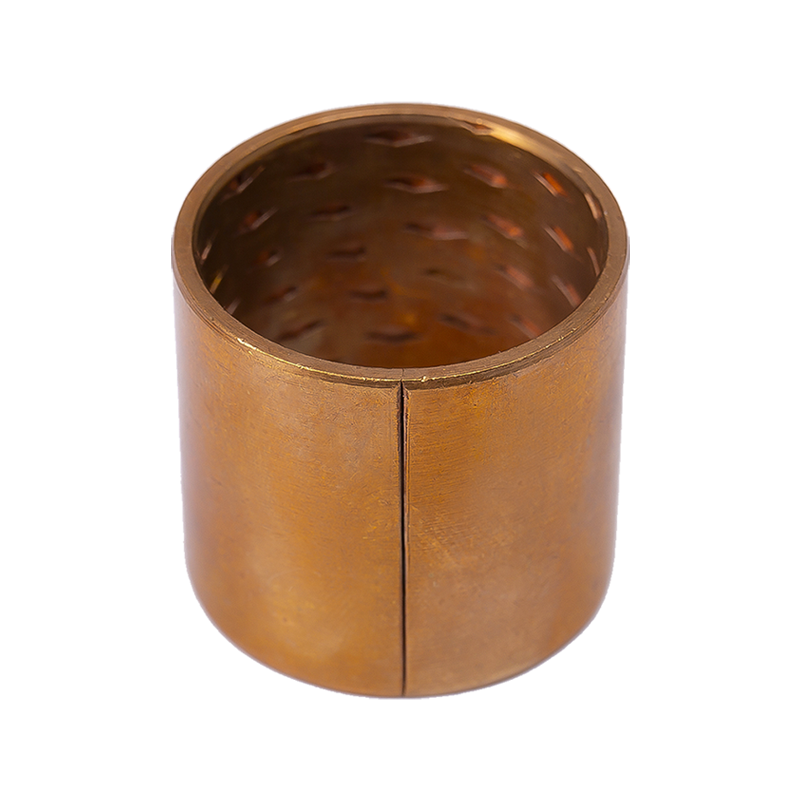 HZ090 Tin Bronze Oil-Groove BushingsThin-wall CuSn8P tin bronze bushings with oil grooves store grease and suit medium-to-high load, medium-to-low speed, humid or high-temperature duties.View Product →
A tin bronze oil-groove bushing is the reference point most drawings should start from; deviations upward in load or temperature should be justified by the duty, not by habit.
Where Bronze Bushings Actually Get Used
Demand follows the joints that cannot afford a seizure: places where the shaft is expensive, the access is poor, or the downtime is measured in shifts.
- Automotive chassis, dampers and pedal boxes: 32 percent
- General machinery linkages and conveyors: 26 percent
- Agricultural and off-highway equipment: 17 percent
- Pumps, valves and fluid power: 15 percent
- Marine, rail and other: 10 percent
Illustrative split based on typical bronze bushing consumption; the real mix shifts with program and region.
From Drawing to First Article: A Sourcing Sequence
- Fix the duty first. Radial load, speed, PV, duty cycle, ambient and joint temperature, contamination. Everything downstream depends on these six numbers.
- Choose the structure before the grade. Solid bronze, bronze-backed bimetal, or graphite-inlaid bronze.
- Set the fit with heat in mind. Bronze expands faster than steel: at a 100 mm bore and an 80 degree rise, bronze grows about 0.14 mm against about 0.10 mm for the housing, so roughly 0.05 mm of interference disappears when the joint is hot.
- Define the lubrication features. Groove pattern, hole position, pocket depth and bore-entry chamfer, each with a tolerance rather than a note.
- Agree the inspection plan. Chemistry and heat number, hardness, wall thickness, bore after press-fit, groove depth and surface finish.
- Run the first article in the real joint and log steady-state temperature, not just a bench pass.
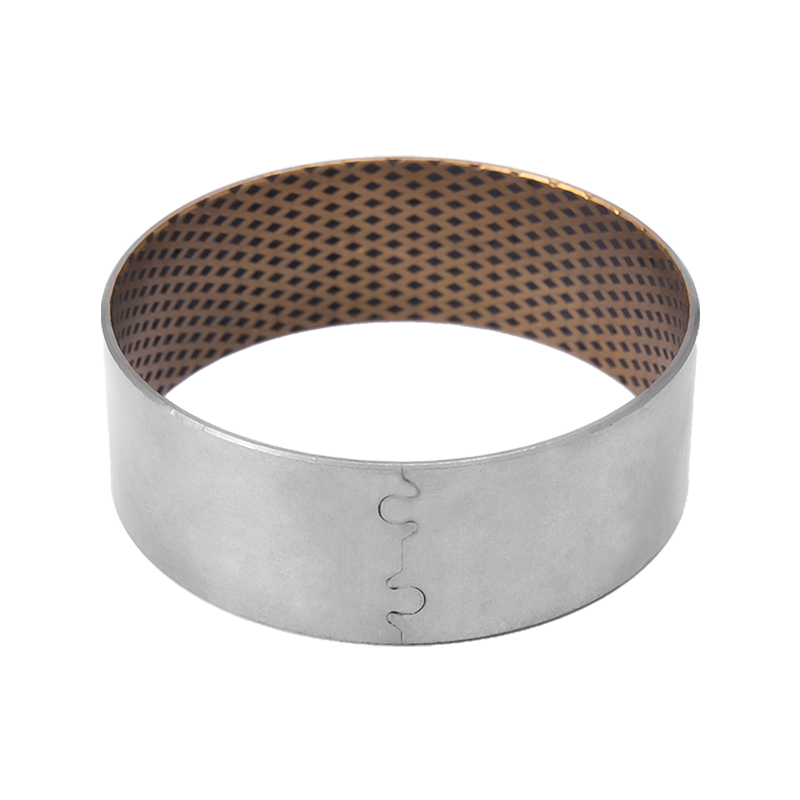 HZ08G Bimetallic Graphite Copper BushingsSteel-backed bimetallic bushings with embedded graphite suit high-load, high-temperature duties such as starter motors, gearboxes, generators, cranes, and metallurgical machinery.View Product →
A thin-wall bimetal composite bushing is often the answer at step two, because a steel backing carries the interference fit while a thin bronze layer does the bearing work.
Maintenance and Compliance Notes
- Watch temperature, not noise. A steady 10 to 15 degree rise usually means the film is thinning, well before the joint starts complaining.
- Read worn parts before scrapping them. A polished crescent is edge loading, a matte scratched bore is contamination, a black gummy film is grease breakdown. Each points to a different fix.
- Insist on a material certificate. "Bronze" on a drawing is not a specification; C93200 with a heat number and chemistry report is.
- Check lead declarations. Most cast tin bronzes carry lead, so RoHS, ELV and REACH statements matter for automotive and electronics-adjacent programs. Lead-free alternatives exist, but they trade away part of the conformability that made bronze attractive.
- Keep groove and oil-hole records. A bushing that is correct on paper fails when a supplier turns a 3 mm groove into 1.5 mm and nobody measures it.
Before a first production lot, request the supplier's factory certifications and material declarations, and file them with the drawing revision they belong to.
Bronze costs more per kilogram and machines more slowly. On a joint that is hard to reach and expensive to stop, that is still the cheaper number.