English
 русский
 Español
 عربى

A 40 mm cast-bronze bushing on a slow, shock-loaded conveyor pivot can fail within months when grease is treated as an installation detail; the same joint can last for years when lubricant type, groove pattern, clearance, and relubrication interval match the duty cycle.
Bronze is not self-lubricating by itself. Cast and wrapped bronze bushings rely on an oil film, a grease reservoir, or boundary additives. Graphite-embedded bronze and PTFE-lined bushings are separate families; they change the maintenance strategy rather than remove every lubrication risk.
Content
- 1 Start With the Operating Envelope, Not the Grease Catalog
- 2 Grease or Oil? Match Viscosity, Feed Method, and Relubrication Access
- 3 Grooves and Holes Decide Whether the Lubricant Reaches the Load Zone
- 4 What a Worn Bushing Tells You About Lubrication
- 5 Industry Application Split: Where Boundary and Oil Lubrication Fit
- 6 ROI and Selection Workflow: Where Lubrication Choices Pay Back
- 7 Maintenance and Compliance: Intervals, Contamination, and Records
Start With the Operating Envelope, Not the Grease Catalog
The first question is not “grease or oil?” but “what does the joint do?” A bronze bushing in a low-speed pivot with impact loading has a different lubrication problem from a continuously rotating shaft that needs heat removal. Write down the duty before choosing a lubricant grade.
- Load and shock: steady load, reversing load, and peak shock decide whether a grease reservoir or an oil film is more reliable.
- Sliding speed: slow pivots tolerate grease; higher speed usually needs oil circulation or a controlled oil feed.
- Temperature: heat lowers viscosity and accelerates oxidation; high-temperature joints need a stable base oil and compatible thickener.
- Access and position: a horizontal joint with a top-mounted grease nipple is easy to service; an inverted, enclosed joint may justify a maintenance-free alternative.
- Contamination: dust, water, and process slurry can turn a good lubricant into an abrasive paste, so seals and relubrication discipline matter as much as the lubricant.
Full-film target
Oil is preferred when speed and heat make a continuous film possible. The oil must reach the load zone and carry heat away.
Boundary target
Slow, heavily loaded joints often run in boundary lubrication. The additive package and grease retention become the wear-control system.
Starvation risk
If the lubricant cannot be replenished or retained, a premium product will not protect the bushing for long. Design the feed path before choosing the grade.
Grease or Oil? Match Viscosity, Feed Method, and Relubrication Access
For many slow, heavily loaded pivots, an NLGI 2 lithium or lithium-complex grease with EP/AW additives is a practical starting point. For higher speed or heat removal, oil is usually better because it can circulate and carry heat away. The base oil viscosity matters as much as the NLGI grade.
One common procurement risk is EP additive compatibility. Some sulfur-phosphorus EP packages can attack copper alloys, especially at elevated temperature. Specify a yellow-metal compatible grease or oil and verify it with the lubricant supplier. Do not assume “EP” means “bronze-safe.”
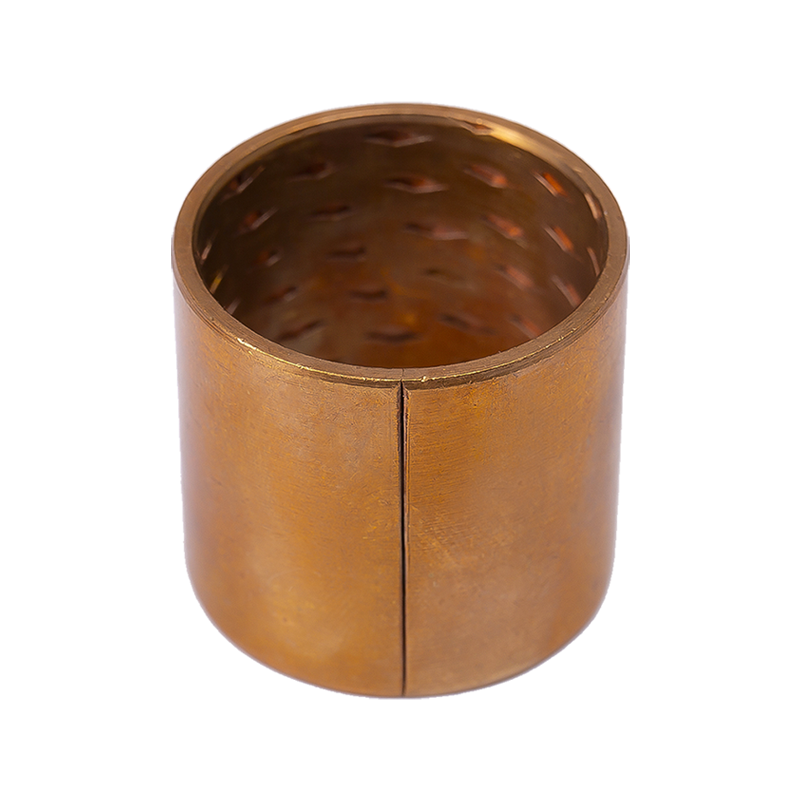 HZ090 Thin-Wall Tin Bronze Oil-Groove BushingThin-wall CuSn8P tin bronze bushing with rolled oil holes and grooves; review groove placement and use yellow-metal-compatible lubricant for reliable feed.View Product →
For oil-lubricated joints, the feed method is part of the specification. A drilled hole that ends in the unloaded side, a shallow axial groove, or a small pocket can be more effective than a large groove that weakens the wall or bypasses the load zone.
Grooves and Holes Decide Whether the Lubricant Reaches the Load Zone
A groove is not decoration. It is a distribution channel, and its position matters more than its cosmetic shape. Put the oil hole or grease pocket where the lubricant can enter the clearance space without cutting through the highest loaded area.
- For oil, use an axial or spiral groove in the unloaded zone and deburr every hole. A sharp edge can scrape the shaft and create a wear path.
- For grease, a pocket or single feed groove is often enough. Too many grooves can reduce effective bearing area and make the grease escape rather than stay in the load zone.
- For reversing loads, confirm the feed point with the actual load direction. A groove that works in one rotation direction may sit in the loaded zone when the shaft reverses.
- For thin-wall bushings, avoid over-sizing the groove. Feed features should be sized for flow, not for visual symmetry.
Clearance and shaft finish complete the lubrication system. A starting point for general bronze bushings is diametral clearance around 0.1–0.2% of shaft diameter, but thermal growth, load, and shaft finish can move that target. A shaft finish in the Ra 0.4–0.8 micron range often supports oil retention without tearing the film; too rough wears the bronze, while too smooth can reduce wetting in some oils.
What a Worn Bushing Tells You About Lubrication
The wear pattern is the cheapest diagnostic tool in the maintenance room. Before changing grease brands, read the bushing: scoring in the load zone points to starvation or contamination; black staining or pitting can indicate EP additive attack or overheating; oval wear suggests misalignment; cracks near a groove point to stress concentration.
A bushing that is polished but dry usually ran with insufficient lubricant. A bushing with gritty embedded particles ran with poor sealing. A bushing with localized heat discoloration may have used the wrong grease or too much preload. These observations should feed back into the lubricant specification, not just trigger another replacement.
Industry Application Split: Where Boundary and Oil Lubrication Fit
The right lubrication mode varies by application emphasis. Automotive chassis and suspension joints often favor grease because of shock and intermittent motion. General machinery may use oil bath or circulation where heat removal matters. Heavy equipment and agricultural machines usually need grease with robust seals and contamination control.
For a deeper comparison of lubrication regimes, see boundary-lubricated bearing fundamentals. The key distinction is whether the application can maintain a film or must rely on boundary additives and controlled replenishment.
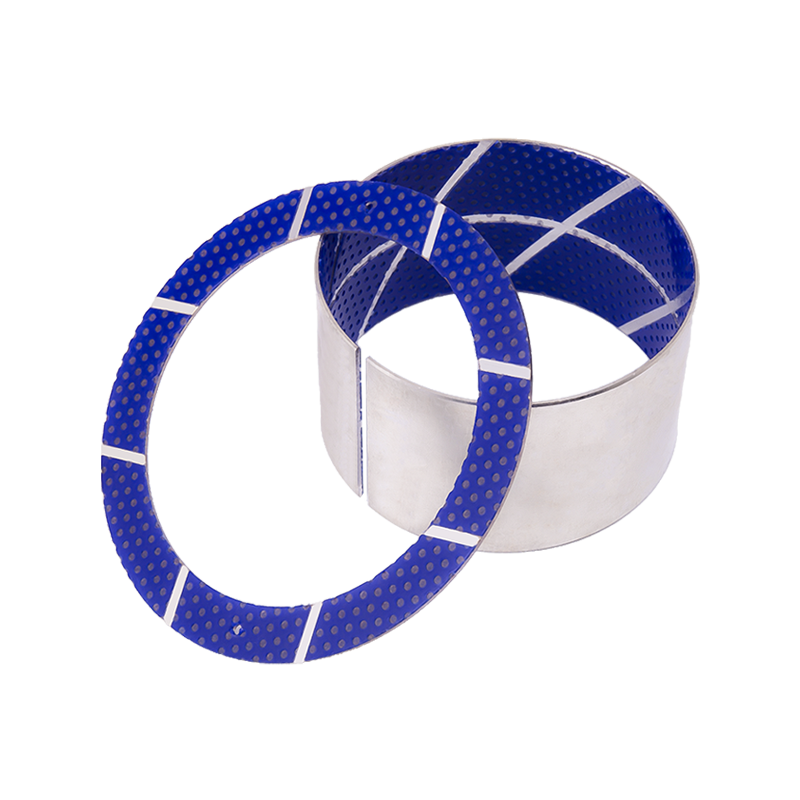 HZ2B Porous Sintered Bronze-POM Boundary BearingSteel-backed sintered bronze and blue POM sliding layer for grease-lubricated boundary applications; consider relubrication access and total maintenance cost.View Product →
ROI and Selection Workflow: Where Lubrication Choices Pay Back
Lubricant price is rarely the largest cost. Labor, downtime, seal damage, and premature replacement usually dominate. A grease with a low shelf price can be expensive if it requires monthly access to a hot, guarded joint. A higher-cost oil system can pay back when it removes heat and extends bearing life.
Record load, speed, temperature, shock, mounting orientation, and service access.
Use grease for retention and shock; use oil for speed, heat removal, and circulation.
Place holes, grooves, and pockets in the unloaded zone and deburr every edge.
Base the first interval on contamination, temperature, and access; adjust from inspection data.
Start at low load and speed, watch temperature, and confirm the lubricant reaches the joint.
Read wear patterns and adjust grease chemistry, interval, or bushing design before repeating the failure.
A simple ROI check is cost per 1,000 operating hours: lubricant cost plus labor plus downtime plus premature replacement. If access is difficult, a boundary-lubricated or self-lubricating option may win even at a higher unit price because it removes repeated service trips.
Maintenance and Compliance: Intervals, Contamination, and Records
Use condition-based triggers, not only calendar intervals. Grease color, vibration, temperature rise, and wear debris are early warning signals. A joint that runs 5 C hotter after relubrication may be over-greased, misaligned, or using a thickener that does not release oil at the operating temperature.
- Clean industrial grease starting point: 500–1,000 operating hours or 3–6 months for a slow, heavy pivot; shorten in dust, water, or high temperature.
- Oil bath: check level weekly, inspect for water and particles, and change at 2,000–4,000 hours or according to oil analysis.
- Run-in: 30–60 minutes at low load and moderate speed, with temperature checks, helps seat the surfaces without overheating the lubricant.
- Records: log lubricant type, batch, quantity, interval, and inspection findings. A grease change without a record is difficult to troubleshoot.
- Compliance: keep safety data sheets available, confirm REACH or RoHS requirements for export markets, and use food-grade lubricants only where the application requires them.
When relubrication access is poor, a boundary-lubricated or graphite/PTFE self-lubricating bushing can reduce maintenance frequency, but it is not a drop-in swap. Check load capacity, speed limit, shaft hardness, and clearance before changing the bearing family.
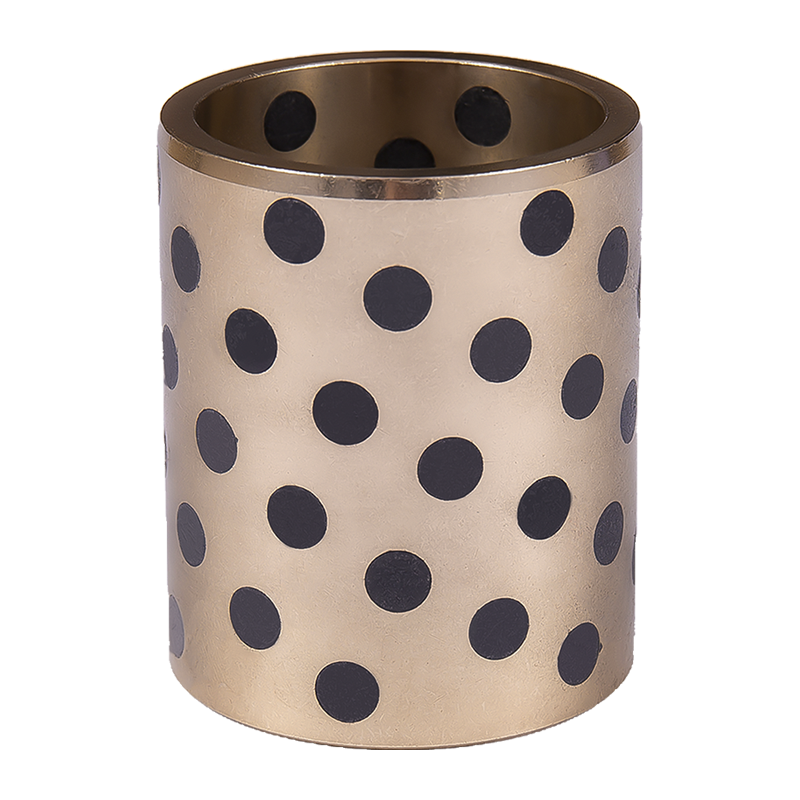 HZ-JDB Graphite-Embedded Bronze Maintenance-Free BushingGraphite-embedded bronze bushing for high-load intermittent or oscillating motion; verify load, speed, shaft hardness, and clearance before replacing an existing bearing.View Product →
The practical rule is simple: match the lubricant to the operating envelope, verify bronze compatibility, feed it to the load zone, and inspect the wear pattern before changing suppliers. A bronze bushing that is properly lubricated and correctly installed is a long-life component; one that is greased by habit is a recurring downtime item.