English
 русский
 Español
 عربى

A 60 mm bronze bush on a crusher eccentric shaft ran warm for two weeks, then scored the journal and stopped the line. The post-mortem turned up nothing exotic: the alloy was a generic "bronze" bought on price, the bore had been reamed 0.04 mm tight after press fitting, and the grease groove had been installed facing away from the load zone. Three small decisions, one expensive failure.
Bronze for bearings is not a single material. It is a family of copper alloys whose tin, lead, zinc and aluminium content decides how the bush behaves under load, heat and contamination. Picking the right one is mostly a matter of matching the alloy to the lubrication you can realistically maintain.
The practical conclusion: specify bronze when you need load capacity, shock tolerance, heat resistance and repairability in one part. A high-leaded tin bronze in the C93200 family covers most grease-lubricated industrial bushes; high-tin and aluminium bronze take the slow, heavy, shock-loaded positions; graphite-plugged or PTFE-lined variants exist for the cases where grease can never reach the joint. Choose by chemistry and lubrication mode, never by colour.
Content
What "Bearing Bronze" Actually Means
Bronze is copper alloyed primarily with tin. Bearing grades then add lead for lubricity and embeddability, zinc for castability and cost, or aluminium and nickel for strength. The three numbers that matter on a drawing are tin content, lead content and hardness — the trade name on the certificate matters far less.
Delivery form also changes behaviour. A continuously cast or centrifugally cast bush has a dense, uniform structure and can be re-machined. A sintered bronze bush is porous and holds oil in the pores, which suits low-load, low-speed duty but limits load capacity. A rolled bimetal strip — bronze on a steel backing — gives a thin, hard, high-load bearing with a steel shell that press-fits like a steel part.
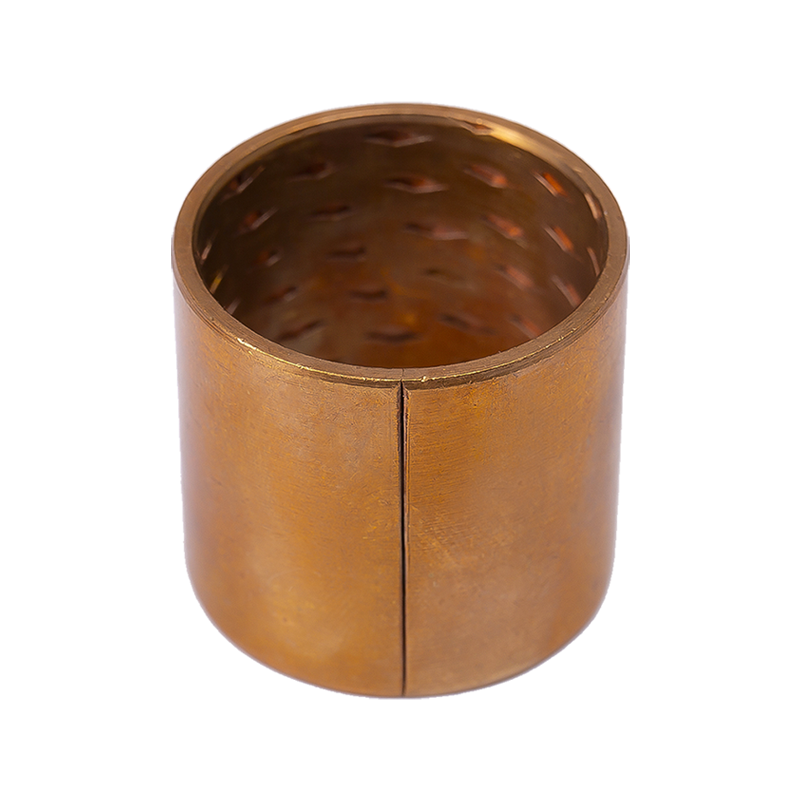 HZ090 Tin bronze oil groove monometallic copper bushingThe major feature of HZ090 series bushing is their thin-wall structure, which doesn’t take up too large assembly space. Specially formulated high-density bronze alloy ...View Product →
The most common mix-up is bronze versus brass. Brass is copper plus zinc: it machines faster, costs less and looks identical in the box, but it deforms under load, work-hardens poorly at the bore and gives up earlier on shock. If a supplier quotes "copper bush" without a grade, ask for the chemistry — that single question separates two very different service lives.
Why Bronze Carries Load Without Seizing
Conformability
The bush yields locally at high spots and spreads contact across the bore, so the pressure peak drops instead of concentrating on a single band.
Embeddability
Soft lead phases bury grit and wear debris below the running surface. A hardened steel bush would instead lap the shaft with that same contamination.
Heat path
Tin bronze conducts heat away from the oil film roughly an order of magnitude better than engineering plastics, which is why marginal lubrication survives longer.
Repairability
The bush is the sacrificial part. It can be reamed, scraped or replaced on site while the shaft — the expensive item — stays in service.
The limits are just as real. Bronze is heavy, it is not a high-speed low-load material, and it demands a shaft that is harder and smoother than itself — typically 2 to 3 times the surface finish quality you would accept against a polymer bush. Run a soft or roughly ground journal against bronze and the shaft becomes the wear part.
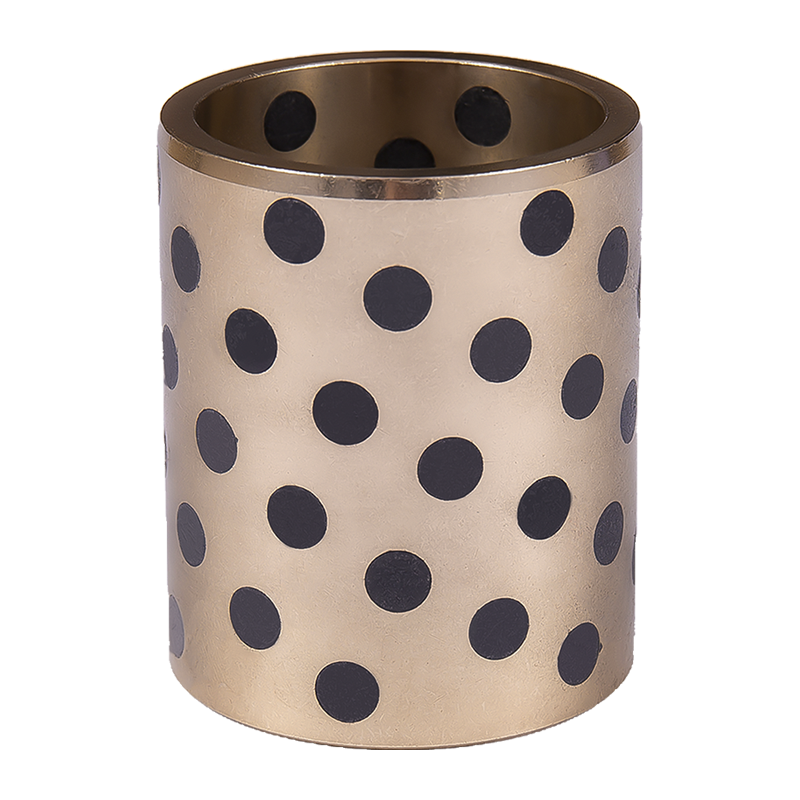 HZ-JDB Graphite Copper Bushing SeriesExplore the JDB-1 to JDB-5 solid-lubricant bronze bushings for high-load, intermittent or oscillating motion, with multiple alloy options and standard sleeve/flange sizes.View Product →
Load, Speed and Temperature: Reading the Numbers
Selection lives or dies on PV — contact pressure multiplied by surface speed. The chart below compares indicative allowable PV for common bearing options under continuous duty; treat it as a screening tool, not a guarantee, because clearance, finish and cooling shift the real limit considerably.
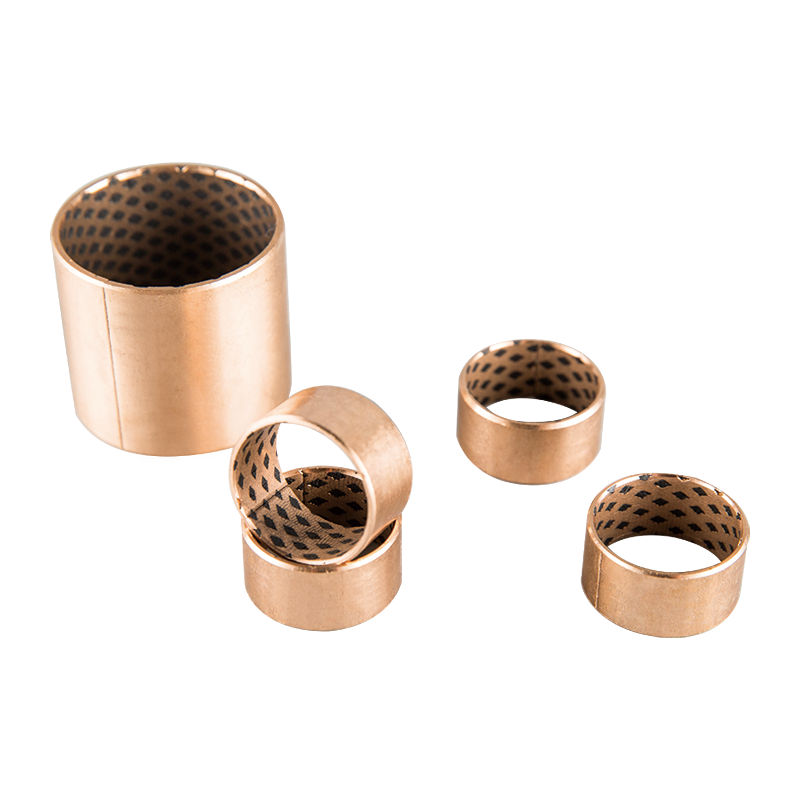 HZ09G Bronze Rolled Bimetallic Composite BearingView the HZ09G bronze bimetallic bearing with graphite-filled lubrication indents for short oil-free running, available as bushes, thrust washers, strip and custom parts.View Product →
Where Bronze Bushes Actually Sit in the Market
Cast and rolled bronze remains the default bearing material wherever loads are high, speeds are moderate and maintenance access is limited. The split below reflects typical industrial consumption patterns rather than a single survey, but it explains why most catalogue stock is still high-leaded tin bronze.
- Automotive chassis and suspension: 32%
- General machinery and drives: 26%
- Pumps, valves and fluid handling: 16%
- Agricultural and off-highway: 14%
- Other industrial equipment: 12%
Automotive work is dominated by flanged and reverse-form bushes in damper and steering joints, where the bush must absorb shock and hold alignment without lubrication for long stretches. Pump and valve duty leans toward gunmetal because water contact punishes any alloy with a poor corrosion profile, while heavy machinery prefers bimetal strip or aluminium bronze where the load is brutal and the speed is low.
A Selection Sequence That Survives Audit
Step 1
Define the duty: load direction, peak and continuous PV, ambient and running temperature, contamination, and whether anyone will actually grease the joint.
Step 2
Fix the lubrication mode first. It removes more candidate materials than any strength calculation and sets the maintenance cost for the next decade.
Step 3
Pick the alloy family, then the delivery form: cast, sintered, rolled bimetal or graphite-plugged. Each carries a different lead time and price band.
Step 4
Set the fit. Press-fit interference of roughly 0.1–0.15% of bore diameter is typical for bronze; too much closes the bore and destroys clearance.
Step 5
Verify on a sample: certificate chemistry, hardness, bore measurement after installation, and a run-in check before full production release.
The cost logic is straightforward once it is written down. A generic brass bush might save 20% on the part price; a seized shaft and a lost shift cost far more than the difference across the whole batch. Where the volume is large, the cheapest lever is usually the fit and the groove position, not the alloy itself — a correctly specified C93200 bush routinely outlasts an expensive alloy installed with the wrong interference.
Installation, Maintenance and Compliance
Most bronze bush failures we see are installation failures wearing a material costume. Press the bush in squarely, ream or bore to final clearance after fitting — never assume the pre-fit bore is the running bore — and confirm clearance with a bore gauge rather than a caliper. Grease grooves and holes must be checked against the load direction after assembly, not before. The detail behind these steps is covered in this guide to bronze bushing lubrication, groove and clearance practice.
On the compliance side, leaded bronzes deserve an early check against the destination market. Lead-bearing grades can fall inside restricted-substance rules for electrical equipment and vehicle end-of-life, and potable water applications increasingly demand lead-free chemistry or a polymer alternative. Ask for a material declaration with the certificate — retrofitting documentation after a shipment lands is far more expensive than choosing a lead-free grade at the quotation stage. Manufacturing documentation, including the scope covered by our factory certifications, should be requested together with the first sample, not after the first complaint.
- Record the installed clearance and the shaft finish for every critical joint; these two numbers explain most failures later.
- Set a grease interval based on running hours and temperature, and treat missed intervals as a design input rather than an operator error.
- Keep one spare bush per critical position; a stocked sacrificial part is cheaper than an unplanned shaft replacement.
- Re-check alloy chemistry whenever a supplier changes, even if the part number stays the same.
Bronze remains the workhorse bearing material for one honest reason: it fails gradually and it protects the shaft. Specify it by chemistry, match it to the lubrication you can maintain, control the fit, and it will deliver years of quiet service. Specify it by colour and price alone, and the next failure investigation will start exactly where this article began.