English
 русский
 Español
 عربى

A maintenance crew pulls a bronze sleeve out of a conveyor pulley nine months after installation. One side is polished bright, the other is smeared black, and the shaft underneath is untouched. The load is modest, the speed is low, and nothing in the duty cycle looks difficult — which is exactly the clue.
Bushings rarely fail because the material was too weak. They fail because the grade was matched to the wrong lubrication regime, the fit was copied from an old drawing, or edge loading was never calculated. The bushing is the cheapest item on the shaft and the one that sets your maintenance interval, so it deserves a decision rather than a part number.
The short version: pick the family by lubrication regime first, confirm it against pressure times velocity and temperature, then fix clearance, fit and shaft finish. Material brand is the last variable, not the first.
Content
- 1 What a Bushing Actually Does in an Assembly
- 2 The Five Bushing Families Most Projects Specify
- 3 Load, Speed and PV: The Numbers That Decide the Grade
- 4 Where Bushings Are Used: The Application Split
- 5 A Selection Workflow That Survives an Audit
- 6 Fits, Clearance and Installation Details That Decide Life
- 7 Maintenance, Documentation and Compliance
What a Bushing Actually Does in an Assembly
A bushing is a plain bearing: a sleeve that spreads load across an area instead of passing it through rolling elements. That single difference explains both why bushings survive dirty, shock-loaded, slow-moving applications and why they cannot be pushed to the speed limits of a ball bearing.
Every bushing in a design has to do three jobs at once:
- Carry radial, axial or combined load at a contact pressure the material can survive.
- Control friction over the full service interval, including start-up when the oil film is thinnest.
- Tolerate misalignment, thermal growth and contamination without a cage to jam or brinell.
Quiet and shock-tolerant
No rolling contact means no chatter marks and far better behaviour under impact loading.
Radially compact
A thin-wall sleeve often fits where a rolling bearing with the same bore would not.
Harsh-environment ready
Dust, grit and water shorten rolling bearing life far faster than they shorten a plain sleeve.
Speed-limited
Heat generation rises with velocity, so high-speed shafts usually belong on rolling elements.
Bushing, bush, sleeve, plain bearing — same part, different paperwork
Purchasing teams see all four words, and the distinction matters at quotation stage. A "bush" is the same sleeve under British usage; a "flanged bushing" adds an integral thrust face; a "thrust washer" handles axial load only. Mixing the terms on a requisition is a common source of delivered parts that fit the bore but not the assembly.
The Five Bushing Families Most Projects Specify
Nearly every industrial enquiry lands in one of five groups. They differ less in shape than in how the lubricant reaches the sliding surface.
For dry or marginally lubricated rotating joints, the steel-backed PTFE group is usually the first candidate because the wall is thin, friction is low and no relubrication route has to be designed into the housing.
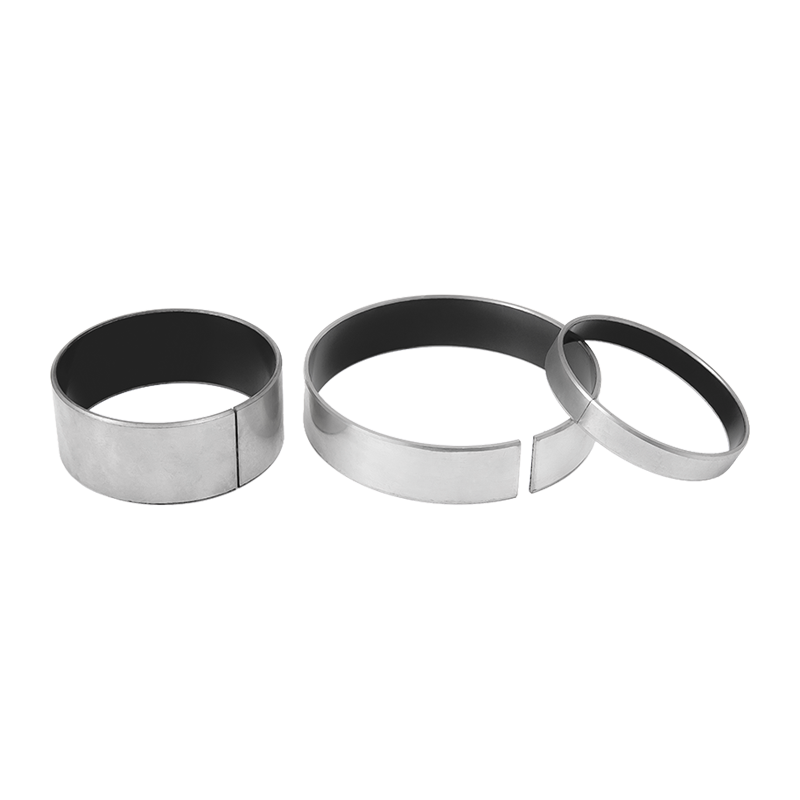 HZ10 Type 1 Steel-Backed PTFE Self-Lubricating BearingMaintenance-free thin-wall plain bearing for dry or minimal-oil rotating joints, with low friction and no relubrication route.View Product →
Elastomer bushings solve a different problem
Polyurethane and rubber bushings appear in suspension arms, anti-roll bars and body mounts. They are not sliding bearings at all: the elastomer deflects to isolate vibration and allow multi-axis movement with no lubricant. Their failure mode is tearing, cracking or permanent set after ageing — not the adhesive wear that governs a bronze or PTFE sleeve. If a drawing specifies a poly bush, a metallic sleeve is not an upgrade; it is a different function.
Load, Speed and PV: The Numbers That Decide the Grade
PV — contact pressure in MPa multiplied by sliding velocity in m/s — is the fastest screening number available. It is not a material constant. The same bronze behaves differently at 0.05 m/s and 0.5 m/s, and differently again at 120 °C. Use published envelopes as a starting gate, then verify with a sample run.
Two corrections catch most mistakes. First, reduce the allowable PV as ambient temperature rises, because a plastic layer softens and a bronze loses oil viscosity. Second, remember that a shock-loaded linkage can see three times its nominal pressure at the edge of the bore. Where heat is the binding constraint rather than load — kiln dampers, oven conveyors, exhaust-adjacent brackets — a solid-lubricant grade with graphite keeps working past the point where grease carbonises.
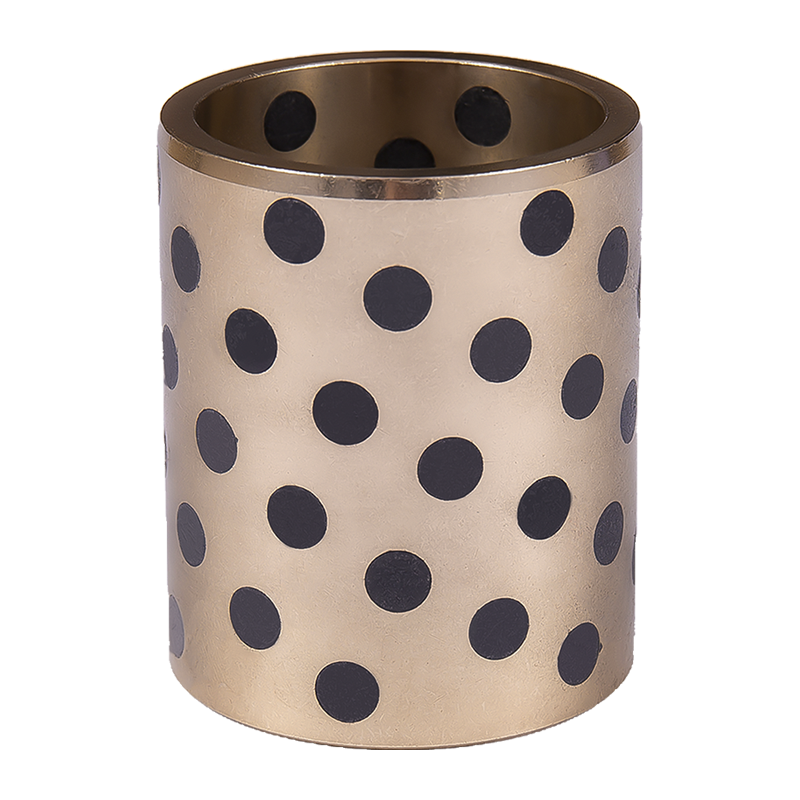 HZ-JDB Graphite Bronze Maintenance-Free Bushing SeriesFor high-load, intermittent or oscillating motion where heat limits grease, with solid lubricant in a bronze matrix.View Product →
Where Bushings Are Used: The Application Split
Demand is concentrated in a handful of sectors, and each one buys differently. Automotive work arrives with PPAP files, tolerance stacks and annual volumes; general machinery arrives with a drawing and a delivery date.
The practical reading: if your programme sits in the automotive slice, expect material certificates, dimensional reports and first-article approval before the first container ships. Agricultural and conveyor applications are more forgiving on documentation but far harsher on contamination, so specify grease retention and dirt exclusion rather than tighter tolerances.
A Selection Workflow That Survives an Audit
Six steps, in this order, resolve most enquiries without a prototype loop.
1. Define the motion
Continuous rotation, oscillating, or axial only? A 30° oscillation needs different lubrication than a fully rotating shaft.
2. Calculate pressure and velocity
Use projected area (bore × length), not the full surface. Add shock factors for linkages and reversing loads.
3. Choose the lubrication regime
Maintenance-free, grease-nippled or oil-fed. This decision eliminates two or three families immediately.
4. Set fit and clearance
Housing and shaft tolerances, interference, and the clearance left after pressing decide the running film.
5. Specify the counterface
Surface finish and hardness of the shaft matter as much as the bushing; a rough shaft wears any liner out.
6. Validate one batch
Run a sample to the expected service interval under representative contamination before releasing volume.
When step 3 lands on a dry-running light-duty joint, an injection-moulded or machined plastic sleeve is often the lowest-cost route — provided the housing does not run hot enough to soften it.
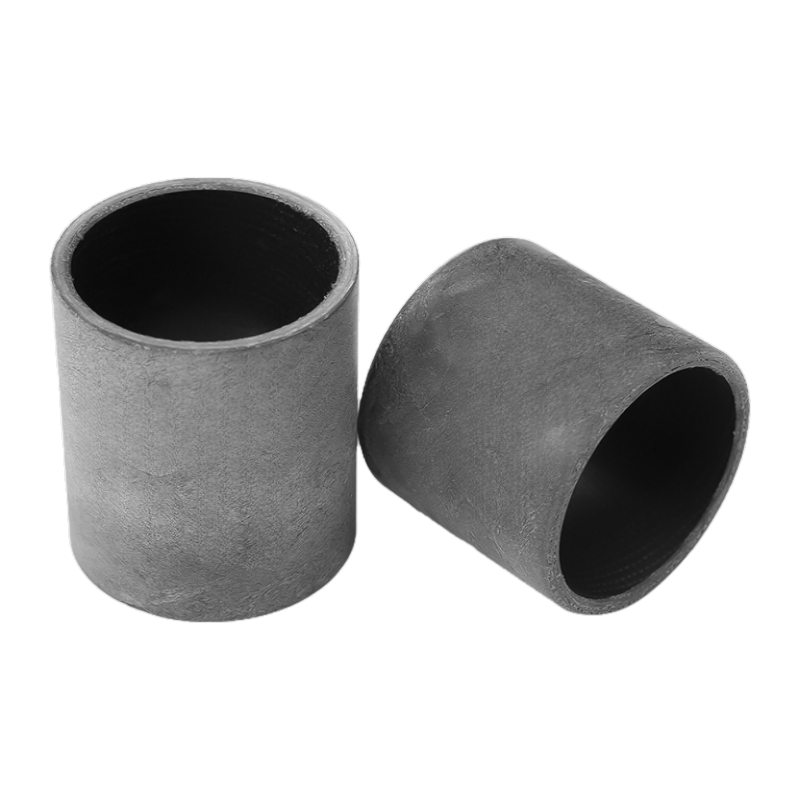 HZ-GSM G-Material Engineering Plastic Dry-Running BearingVersatile maintenance-free plastic sleeve for dry, low-noise mid-to-high-load joints at moderate temperatures and speeds.View Product →
Fits, Clearance and Installation Details That Decide Life
Two installations of the same part can differ threefold in service life purely on fit. The numbers below are conventional starting points, not universal rules:
- Housing bore H7 and shaft h8 or h9 cover most bronze and coated sleeves running with grease.
- A press fit of roughly 0.02–0.05 mm per 25 mm of bore keeps the sleeve from spinning in a steel housing; aluminium housings need a tighter initial grip to allow for thermal growth.
- Pressing closes the bore by approximately the interference value, so finish-bore or ream after fitting when the drawing calls for a tight running clearance.
- Shaft finish of Ra 0.4–0.8 µm and hardness above 200 HB (or a hard-chrome layer) protects both components in abrasive duty.
- Installed running clearance for a dry-running plastic sleeve is wider than for bronze — the material expands more per degree of temperature rise.
Never press on the flange face. A distorted bore at the flange root is the most common cause of a "defective" bushing found at first start-up, and it is almost always an assembly issue rather than a manufacturing one.
Maintenance, Documentation and Compliance
Bushings are usually replaced on condition rather than on a fixed clock. Watch three indicators: a rising housing temperature, grease that turns dark and gritty within a shortened interval, and visible play when the shaft is levered sideways. Any of the three justifies inspection at the next planned stop.
On the paperwork side, buyers in regulated chains increasingly ask for material declarations, dimensional reports and evidence of a controlled quality system before approving a supplier. For automotive programmes, the expectation extends to first-article inspection and traceability back to the material heat number. Zhejiang Huazhou Technology publishes its quality documentation through its factory certifications page, and the company's manufacturing background traces its automotive supply work back to a 2012 sole-supplier agreement with a damper manufacturer — the kind of history that matters when a buyer asks how long a supplier has held a zero-defect record.
Storage deserves a line in the work instruction too. Steel-backed and bronze sleeves stored in unheated warehouses attract condensation; a light oil film and sealed packaging prevent the surface staining that customers reject on incoming inspection, even when the part would perform perfectly well in service.
Get lubrication regime, PV, fit and counterface right, and the rest of the bushing specification usually takes care of itself — which is why the cheapest component on the shaft deserves a documented decision.