English
 русский
 Español
 عربى

A maintenance team replaces a row of bronze bushings with PTFE-lined steel-backed ones, the bench trial looks perfect, and eight months later the housings come back with the lining worn through to bare steel on one side. The shaft is undamaged, the load sits inside the catalogue curve, and the lubrication routine never changed. What failed was not the bearing as a whole; it was the behaviour of the thin working layer sitting on top of it.
That is why coating properties deserve a line of their own in the specification. On a self-lubricating or boundary-lubricated bearing, the functional layer is often only 0.01–0.35 mm of a 1–3 mm wall. Its thickness, adhesion, filler content, porosity and friction stability under the real load-speed cycle influence service life far more than the backing steel grade or the headline load rating.
The short answer
Four coating properties carry most of the risk: running-layer thickness and its tolerance, bond strength to the backing, filler or porosity ratio inside the layer, and friction stability at the actual PV. A 10 µm thickness drift or a 20–30% shift in filler content is enough to halve dry-running life, and neither appears in the single friction coefficient printed on a datasheet.
Content
Coating Properties That Decide Whether a Bushing Survives
Six properties come up again and again when lined bushings are opened up after a premature failure. They are measurable, and they can be written into a purchase order.
- Running-layer thickness and tolerance. Too thin and the layer is cut through during run-in or after a few thousand oscillations; too thick and a soft polymer creeps, insulates heat and loses dimensional stability.
- Bond strength to the backing. Delamination starts at the edge of the contact zone under misalignment and thermal cycling, and it is invisible until the lining peels away in one piece.
- Filler content and porosity. Sintered bronze pores hold the acetal or PTFE composite; the ratio of filler to pore volume controls dry friction, running-in and the ability to trap debris.
- Hardness and embeddability. Soft layers swallow grit and protect the shaft; hard platings resist abrasion but can polish or score a shaft once particles are trapped.
- Thermal conductivity. Polymer layers conduct heat poorly compared with bronze, so the PV limit is really a temperature limit at the sliding interface.
- Corrosion resistance. Plating porosity and layer chemistry decide whether a condensate-heavy plant sees rust streaks within a season.
Friction values by themselves explain very little. A PTFE composite can show a very low dry coefficient and still wear quickly once the counterface is rough or the temperature rises; the fuller picture of PTFE bushing material properties covers that trade-off between low friction, creep and heat.
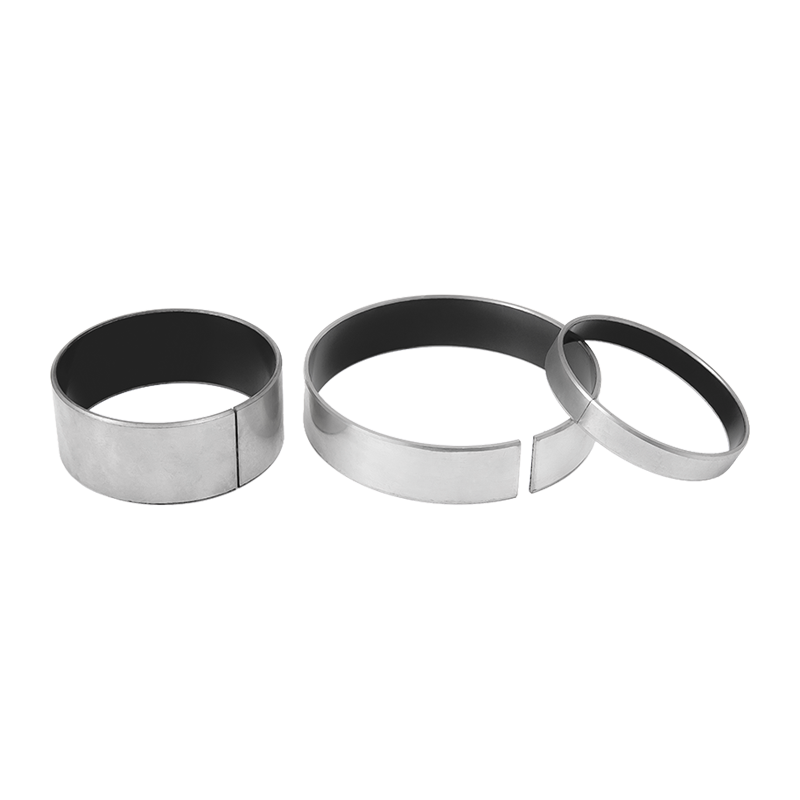 HZ10 Steel-Backed PTFE/Lead Self-Lubricating Plain BearingCombines a steel backing, sintered bronze interlayer and PTFE/lead sliding surface for low-friction, low-wear dry running in linear and rotating movements.View Product →
Typical layer budgets
10–30 µm of PTFE/bronze composite on a 0.5–2.5 mm steel backing; 5–15 µm of copper or tin plating; 0.3–0.5 mm of acetal over sintered bronze.
Counterface budget
Ra 0.2–0.8 µm and roughly 200–350 HV for thin linings. A coarse turned shaft can wipe out a thin running layer in hours, not months.
Temperature ceiling
Acetal-lined layers are usually rated around 100–120 °C continuous; PTFE composites go higher short-term but creep more under sustained load.
Comparing the Common Bearing Surface Layers
The table below puts the five families side by side on the numbers that actually drive selection: layer thickness, dry friction, load guidance and counterface requirement.
The Metrics Datasheets Leave Out
One friction coefficient measured at room temperature and low speed says very little about a bearing that has to survive dust, washdown or a slightly misaligned housing. Wear volume across realistic conditions separates a two-year part from a two-month part.
100
185
240
215
270
Three conclusions follow from that pattern. First, contamination and edge loading dominate wear far more than the base friction number, so porosity that traps grit and a generous edge radius on the layer matter as much as chemistry. Second, water ingress attacks the bond line as well as the polymer, which is why plating and backing grade belong in the same conversation as friction. Third, a supplier who can quote wear depth at 500 hours and salt-spray hours per batch is worth more than one who quotes only a friction coefficient.
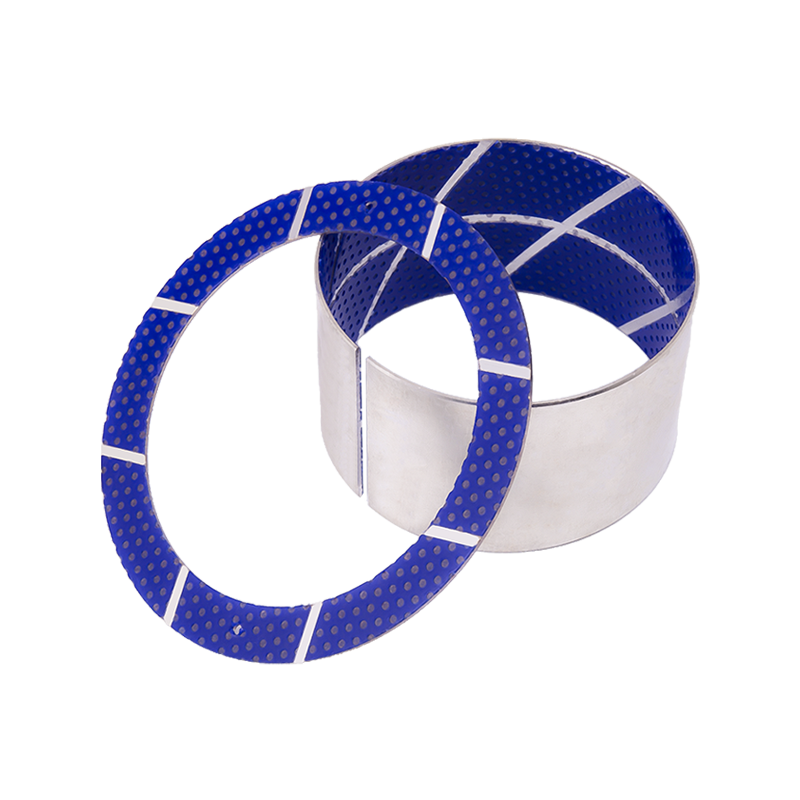 HZ2B POM/Filler Boundary-Lubricated Bearing for Heavy LoadsBlue POM/filler sliding layer on sintered copper and steel suits grease-lubricated swinging and rotating movements in truck axles, brakes and suspension systems.View Product →
Where Lined and Coated Bearings Actually Go
Demand is concentrated in a handful of duty types, and each one stresses a different coating property.
- 32% Automotive chassis and dampers — edge loading and salt spray dominate.
- 24% General machinery and linear motion — dry friction stability over millions of strokes.
- 17% Hydraulics, pumps and fluid power — oil retention and plating integrity.
- 15% Agricultural and off-highway — dirt tolerance and embeddability.
- 7% Food and pharma washdown — stainless backing and layer chemistry.
- 5% Other precision equipment — tight thickness tolerances and low noise.
Screening a Surface Layer in Five Steps
1. Fix the duty point
Write down load, speed, PV, duty cycle, ambient temperature and target hours. Everything else follows from this line.
2. Audit the counterface
Check shaft hardness, surface finish and material grade. Thin linings and coarse shafts are an expensive combination.
3. Choose the lubrication regime
Dry, grease-retained, oil-fed or washed-out. The regime selects the layer family before any price comparison starts.
4. Verify layer data
Ask for thickness tolerance, adhesion or peel results, filler declaration and salt-spray hours. Plated variants such as copper-plated bimetallic bushings live or die on plating porosity, so request the test record rather than the brochure.
5. Validate before volume
Run 200–500 break-in cycles, measure wear depth and friction drift, then lock incoming inspection to thickness and hardness.
 HZ803 Copper-Plated Bimetallic Composite BearingSteel-backed lead-bronze bearing with copper plating for high-load, high-speed lubricated use; the smooth finish reduces start-up friction in pumps and steering systems.View Product →
On cost, the arithmetic is rarely about unit price. A bushing that costs 30% less but fails once in a housing that requires a two-hour teardown usually costs several times the saving, and the downtime figure — not the purchase price — is the number worth putting in the business case.
Maintenance, Incoming Inspection and Compliance
- Fit matters as much as chemistry. Typical press-fit interference of 0.02–0.05 mm keeps the layer from rotating; a loose fit wipes out a thin lining quickly.
- Storage and handling. Keep lined bushings in dry, dust-free packaging; a contaminated running layer behaves like an abrasive one from the first stroke.
- Cleaning agents. Some acetal and phenolic layers swell in strong ketones, so confirm solvent compatibility before washdown routines are standardised.
- Lead-free declarations. Black boundary-lubricated variants with leaded filler need a declared lead-free alternative for EU markets; check the filler statement, not just the product name.
- Documentation. Layer thickness range, adhesion result and salt-spray hours should travel with each batch; documented quality systems, as summarised on the factory certifications page, make that conversation easier.
Treat coating properties as a specification, not a footnote. When layer thickness, bond strength, filler ratio and friction stability at the working PV are written into the drawing and checked at goods-in, the failure mode described at the start of this article stops being a surprise and becomes a number you can manage.