English
 русский
 Español
 عربى
عربى
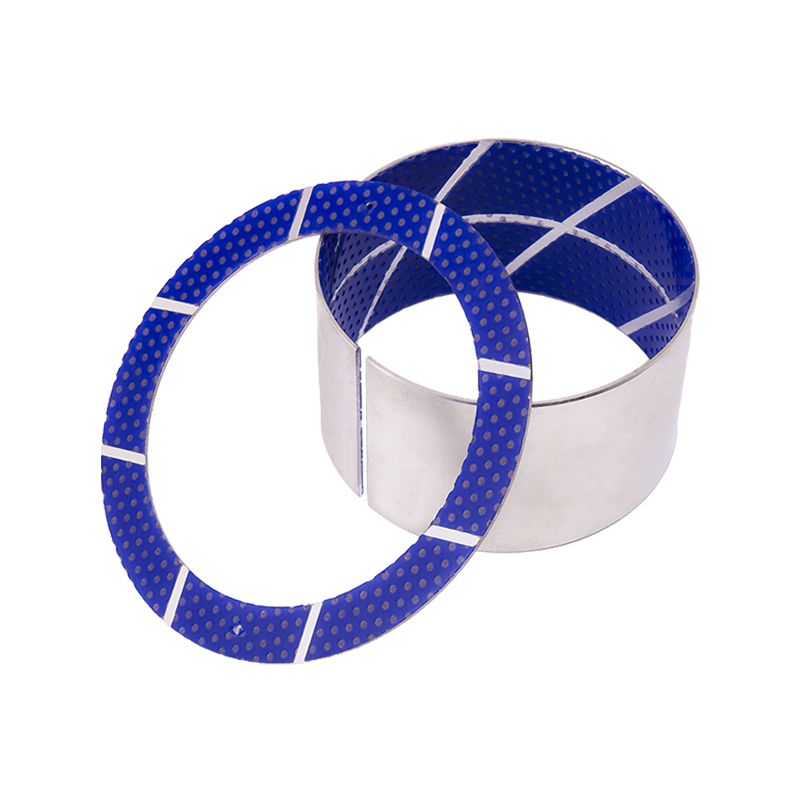
Boundary lubrication bearings deliver a practical, maintenance-friendly upgrade for machinery operating under low-speed, medium-load conditions. Their composite construction—steel backing, sintered spherical bronze, and a modified POM surface with oil storage pits—cuts costs, extends service life, and dramatically reduces re-lubrication needs compared to traditional copper sleeves. This is especially valuable in applications like rolling mills, where simpler replacement and fewer refueling stops directly boost productivity.
Content
How the Composite Structure Achieves Self-Lubrication
The bearing's performance begins with a layered architecture. A steel plate forms a rigid backing, while a sintered spherical bronze powder layer is bonded to it, creating a porous heat-dissipating matrix. Rolled onto this is a modified polyoxymethylene (POM) face, dotted with microscopic oil storage pits. These pits retain lubricant and release it gradually during operation, maintaining a stable boundary film without external oil supply.
The Role of Oil Storage Pits
The pits act as reservoirs, not just texture. At startup, before a full film forms, oil oozes out to lower friction; during running, capillary action draws excess lubricant back, creating a self-regulating cycle. This mechanism enables the bearing to run for 5 to 10 times longer between re-lubrication intervals than a conventional bushing.
Why Modified POM Outlasts Ordinary Plastics
The POM is specifically formulated for bearing duty, with a static coefficient of friction as low as 0.08 against steel and excellent creep resistance. It can withstand continuous operating temperatures up to 80°C without softening, ensuring dimensional stability in most industrial environments.
Cost Savings and Extended Service Life Compared to Copper Sleeves
Switching from traditional copper alloy bushings yields measurable financial and operational gains. The self-lubricating design and wear-resistant POM layer combine to deliver a lower total cost of ownership.
- Reduced material and manufacturing cost: Boundary lubrication bearings typically cost 30–50% less than an equivalent bronze bushing.
- Minimal maintenance: Re-lubrication intervals can be extended by a factor of 5–10, often eliminating the need for frequent oiling entirely.
- Longer service life: In low-speed, medium-load settings, these bearings routinely outlast bronze bushings by 2 to 3 times due to continuous lubrication and high wear resistance.
- Simplified installation: The steel-backed, thin-walled design allows fast press-fit replacement without complex oil grooves, cutting changeover time by up to half.
Boundary Lubrication Bearing vs. Traditional Copper Sleeve
| Feature | Boundary Lubrication Bearing | Traditional Copper Sleeve |
|---|---|---|
| Material cost | 30–50% lower | Higher |
| Lubrication requirement | Self-lubricating, minimal external oil | Regular manual greasing needed |
| Refueling frequency | Reduced by 80–100% | Weekly or daily in harsh conditions |
| Typical service life | 2–3 times longer | Shorter, limited by corrosion and wear |
| Replacement complexity | Quick press-fit, no oil grooves | Machining or casting often required |
Proven Performance in Rolling Mill Applications
Rolling mills subject bearings to heavy loads, shock, and contamination while demanding maximum uptime. Boundary lubrication bearings have become a preferred replacement for copper sleeves in this environment. A steel mill that converted its roll neck supports reported a 70% reduction in unscheduled bearing-related downtime and moved from weekly oiling to monthly inspections, saving hundreds of man-hours annually.
- The thin-walled steel-backed design allows a bearing to be removed and a new one pressed in twice as fast as a bronze sleeve replacement, often without dismantling the entire roll assembly.
- The conformable POM layer accommodates minor misalignments that would cause a rigid bronze bushing to bind or wear unevenly, reducing edge loading failures.
- By eliminating daily greasing, mills simplify maintenance schedules and lower lubricant consumption, a notable cost saving in large plants.
Recognizing the Ideal Application Window
Boundary lubrication bearings are engineered for a specific set of conditions, and selecting them correctly ensures maximum benefit. They excel at low speeds (typically below 0.5 m/s) and medium loads, at normal ambient temperatures. They are not designed for high-speed or high-temperature environments where hydrodynamic or rolling-element bearings are needed. For proper specification, verify:
- Maximum static and dynamic load ratings.
- Shaft surface finish: Ra 0.4–0.8 µm is recommended for optimal POM wear life.
- Continuous operating temperature: stay under 80°C to preserve POM integrity.
Whether the goal is to reduce maintenance in a rolling mill, cut replacement part costs, or simply find a reliable substitute for traditional copper bushings, boundary lubrication bearings provide a proven, self-lubricating solution that pays back quickly through longer life and fewer stoppages.