English
 русский
 Español
 عربى
عربى
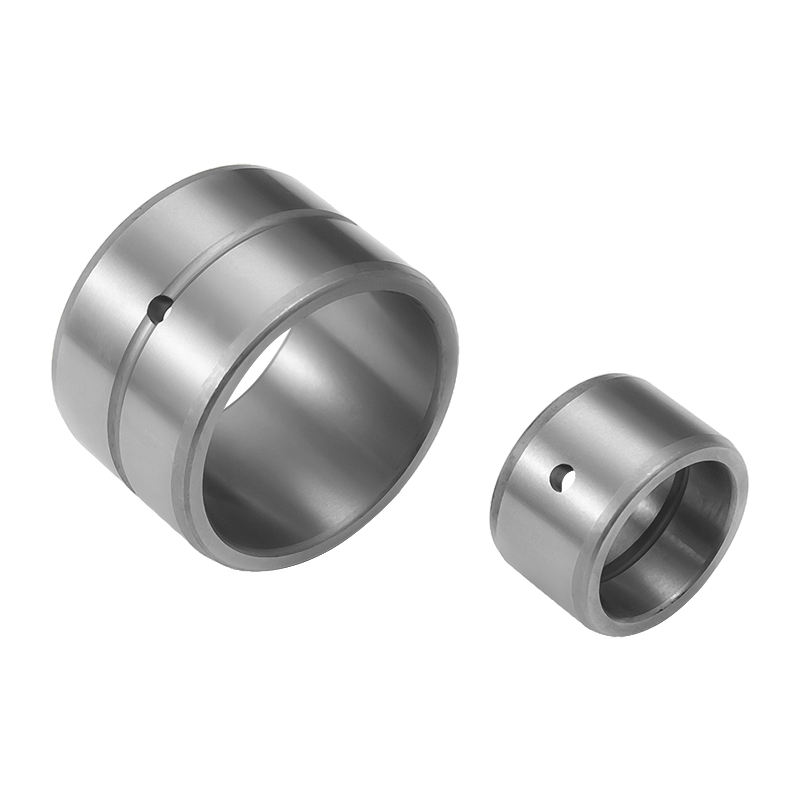
A steel bushing acts as a sacrificial, replaceable wear surface. Its primary job is to protect expensive housing bores and shafts from friction, vibration, and corrosion. Choosing the wrong one leads to premature downtime, but selecting the correct hardened steel variant can extend service life by 300% to 500% compared to an unhardened mild steel part in a high-cycle pivot joint.
Content
Material Grade and Hardness Selection
The metallurgy of the bushing directly dictates where it can survive. Mild steel (like 1018) is machinable but wears quickly under loads exceeding 10,000 PSI. For rotating joints, case-hardened or through-hardened steels are standard.
- AISI 4140/4142: Pre-hardened to Rockwell C 28-32. Excellent for pins with oscillating motion and moderate shock loads. Common in heavy equipment articulation points.
- AISI 52100: Through-hardened to Rockwell C 60-64. Ideal for high-precision needle roller bearing outer races. It provides the highest resistance to brinelling under static load.
- Case-Hardened 8620: Offers a hard surface (Rockwell C 58-62) with a ductile core. It resists cracking in impact-heavy applications like track rollers and rock crushers.
Flanged vs. Straight Cylindrical Designs
The geometry of the steel bushing determines how it handles axial thrust loads. A straight bushing handles pure radial loads, while a flanged bushing absorbs combined loads.
| Design Type | Primary Load Support | Typical Application |
|---|---|---|
| Straight Sleeve | Radial only | Sheave wheels, hinge pins with snap rings |
| Flanged (Type F) | Radial + Axial thrust | Conveyor pulleys, kingpins, gear shift linkages |
The flange eliminates the need for a separate thrust washer, simplifying assembly. However, tight flange radius corners must be undercut or the housing must have a chamfer to avoid stress risers causing cracking under lateral load.
Lubrication Strategy: Self-Lubricating Composites vs. Grease Grooves
Solid steel bushings with graphite plugs eliminate the need for manual re-greasing in inaccessible locations. These graphite-embedded bushings, often manufactured from a high-strength bronze-backed or solid steel matrix, maintain a friction coefficient of 0.15 to 0.25 under dry running conditions. For standard hardened steel bushings, internal grease grooves are critical.
Groove Patterns for Effective Lubrication
If using a lubricated steel bushing, the groove geometry dictates grease retention time. The following patterns are standard and must be selected based on motion type:
- Figure-8 Pattern: Distributes grease evenly across 360 degrees. Best for full rotational motion but weakens the bushing structure if cut too deep—max depth should not exceed 30% of wall thickness.
- Axial Grooves with Stop: Ideal for oscillating motion. Ensure grooves stop short of the bushing edges to prevent lubricant from being pumped out of the joint ends under pressure.
Installation Interference Fit Best Practices
Steel bushing retention relies strictly on a press fit. The interference must be high enough to prevent rotation under peak torque loads. A standard recommended press fit for a steel bushing in a steel housing is 0.001 to 0.002 inches per inch of bore diameter.
A bushing with a 2-inch OD requires 0.002 to 0.004 inches of interference. During installation, the bushing ID will close down proportionally. After pressing, the ID must be resized via burnishing or reaming to achieve the final running clearance with the shaft. A standard running fit after installation is 0.0015 inches per inch of shaft diameter for greased applications. Skipping the post-install sizing step is the most common cause of immediate seizure in high-RPM steel bushings.
Surface Treatment and Corrosion Resistance
While 4140 and 52100 offer high strength, they are prone to red rust in marine or washdown environments. A zinc plating treatment of 0.0002 inches minimum thickness can double the service life in humid conditions by providing sacrificial protection. For chemically aggressive environments, electroless nickel plating preserves the tight dimensional tolerances of the bushing inner diameter while providing a hard, lubricious surface.