English
 русский
 Español
 عربى
عربى
Content
- 1 Structural Characteristics of JF800 Dual-Alloy Copper Bushings
- 2 Dual-Alloy Design and Load Distribution Mechanism
- 3 Performance Under Boundary and Mixed Lubrication
- 4 Resistance to Deformation and Fatigue
- 5 Typical Heavy Load Application Scenarios
- 6 Comparison with Single-Material Copper Bushings
- 7 Why JF800 Bushings Are Selected for Heavy Load Conditions
Structural Characteristics of JF800 Dual-Alloy Copper Bushings
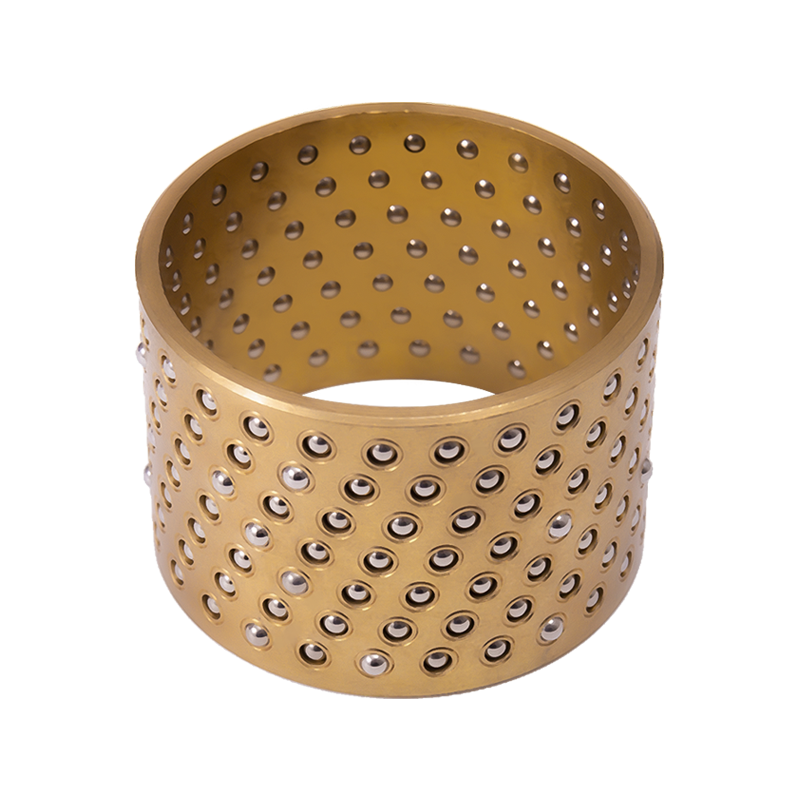
JF800 dual-alloy copper bushings are engineered plain bearings designed to operate under heavy load conditions where conventional single-material bushings may experience rapid wear or deformation. Their structure combines a high-strength steel backing with a copper alloy bearing layer, forming a composite system that balances load-bearing capacity and sliding performance. This dual-alloy construction allows the bushing to withstand high contact pressure while maintaining stable shaft support.
Dual-Alloy Design and Load Distribution Mechanism
The defining feature of JF800 bushings is the dual-alloy configuration. The steel backing provides structural rigidity and prevents deformation under heavy radial loads, while the copper alloy layer offers favorable friction and wear characteristics at the sliding interface. This separation of structural support and tribological function enables the bushing to distribute loads evenly across the contact surface.
Role of Steel Backing in Heavy Load Applications
In heavy load environments, bearing housings are subject to high compressive forces. The steel backing layer in JF800 bushings resists collapse and ovalization, ensuring that the bearing maintains its designed geometry. This stability is essential for preserving consistent clearance between the shaft and the bushing under continuous load.
Function of the Copper Alloy Bearing Layer
The copper alloy layer serves as the primary sliding surface and is formulated to provide good conformability and wear resistance. Under heavy loads, this layer adapts to minor shaft misalignment and surface irregularities, reducing localized stress concentrations that could otherwise lead to premature failure.
Performance Under Boundary and Mixed Lubrication
Heavy load conditions often coincide with low-speed or intermittent motion, where full hydrodynamic lubrication cannot be consistently maintained. JF800 dual-alloy copper bushings are suitable for boundary and mixed lubrication regimes, where metal-to-metal contact may occur periodically. The material composition supports stable sliding behavior during these operating phases.
- Stable friction behavior under high contact pressure
- Reduced risk of seizure during start-stop operation
- Controlled wear pattern that protects mating shafts
Resistance to Deformation and Fatigue
In heavy machinery, bushings are exposed to cyclic loads that can lead to material fatigue over time. JF800 dual-alloy copper bushings are designed to resist fatigue cracking and surface delamination through the strong metallurgical bond between layers. This resistance supports long-term operation in applications where load variation is frequent.
Typical Heavy Load Application Scenarios
JF800 dual-alloy copper bushings are commonly used in industrial and mobile equipment where high load capacity and operational reliability are required. Their design aligns with applications involving slow oscillating motion or continuous high-pressure contact.
- Construction machinery pivot points and joints
- Mining equipment linkages and load-bearing arms
- Industrial presses and lifting mechanisms
Comparison with Single-Material Copper Bushings
| Performance Aspect | JF800 Dual-Alloy Bushing | Single Copper Alloy Bushing |
| Load Bearing Capacity | High due to steel backing | Limited by material strength |
| Resistance to Deformation | Strong under continuous load | Higher risk of distortion |
| Service Stability | Consistent in heavy-duty use | More sensitive to load variation |
Why JF800 Bushings Are Selected for Heavy Load Conditions
JF800 dual-alloy copper bushings are used in heavy load conditions because their composite structure effectively separates load-bearing and sliding functions. This design supports high pressure, resists deformation, and maintains stable friction behavior in demanding environments. For equipment operating under sustained or cyclic heavy loads, these characteristics contribute to predictable performance and extended service intervals.