English
 русский
 Español
 عربى
عربى
Content
- 1 Stable Performance Under Dry and Marginal Lubrication Conditions
- 2 Composite Structure Supporting Boundary Lubrication
- 3 Reduced Dependence on Continuous Lubrication
- 4 Wear Resistance in Low-Speed and Oscillating Motion
- 5 Load Handling Capability Under Boundary Conditions
- 6 Application Flexibility Across Industrial Equipment
- 7 Contribution to Equipment Reliability and Service Life
Stable Performance Under Dry and Marginal Lubrication Conditions
SF2 boundary-lubricated bearings are designed to operate reliably in environments where full fluid lubrication is difficult to maintain. In dry or marginal lubrication conditions, traditional bearings often experience increased friction and accelerated wear. SF2 bearings address this challenge through a composite sliding layer that provides consistent friction behavior even when external lubrication is limited or temporarily absent. This characteristic supports stable motion in applications with intermittent operation or irregular lubrication cycles.
Composite Structure Supporting Boundary Lubrication
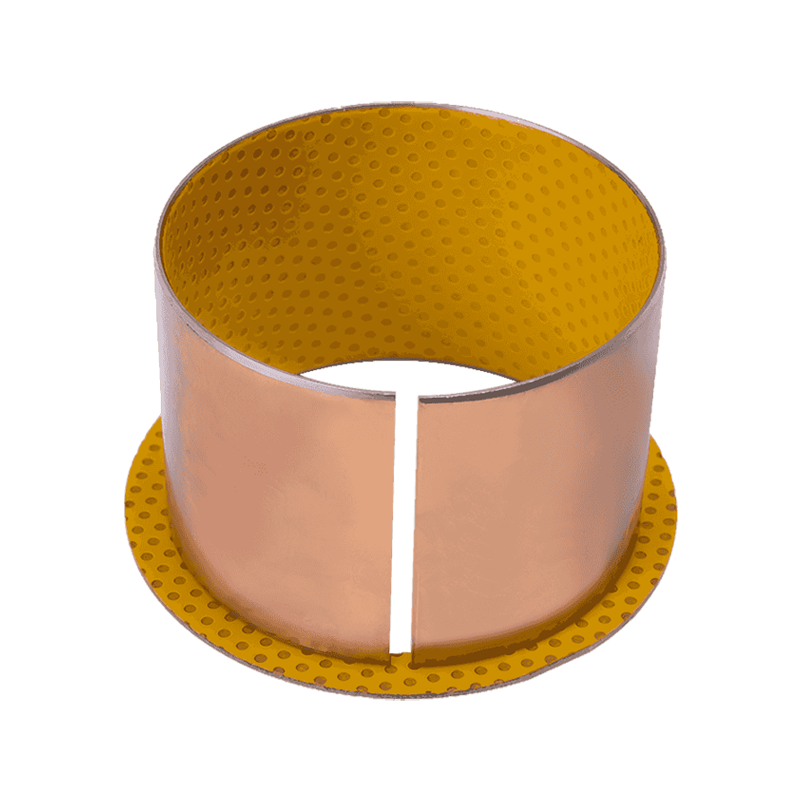
The structure of SF2 boundary-lubricated bearings typically consists of a metal backing combined with a porous bronze layer and a specially formulated sliding surface. This layered construction allows the bearing to retain lubricants while also performing effectively in boundary lubrication regimes. The sliding layer reduces direct metal-to-metal contact, which helps limit friction-related surface damage during startup, shutdown, or low-speed operation.
Role of the Sliding Layer
The sliding layer plays a central role in dry-running capability. It provides a controlled friction interface that remains functional even when lubricant films are thin or uneven. This makes SF2 bearings suitable for oscillating motion, frequent starts and stops, and applications where lubrication supply cannot be continuously maintained.
Reduced Dependence on Continuous Lubrication
One of the primary advantages of SF2 boundary-lubricated bearings is reduced reliance on external lubrication systems. In equipment where access for lubrication is limited or where lubricant contamination is a concern, these bearings offer a practical solution. By maintaining acceptable friction levels under boundary lubrication, SF2 bearings help simplify system design and reduce lubrication-related downtime.
- Suitable for applications with infrequent lubrication intervals
- Supports operation during temporary lubricant loss
- Helps reduce maintenance complexity in confined installations
Wear Resistance in Low-Speed and Oscillating Motion
Dry and marginal lubrication conditions are often associated with low-speed or oscillating movements, where hydrodynamic lubrication cannot fully develop. SF2 boundary-lubricated bearings perform well in these scenarios by providing consistent wear characteristics across repeated motion cycles. This behavior supports stable clearances and predictable performance over extended service periods.
Load Handling Capability Under Boundary Conditions
SF2 bearings are commonly used in applications where moderate to high loads are combined with limited lubrication. The metal backing provides structural support, while the sliding layer distributes contact stress across the bearing surface. This combination allows the bearing to accommodate load variations without rapid surface degradation, even when lubrication conditions are not optimal.
| Operating Condition | SF2 Bearing Advantage |
| Dry operation | Maintains controlled friction |
| Marginal lubrication | Limits surface wear progression |
| Low-speed motion | Stable sliding performance |
Application Flexibility Across Industrial Equipment
SF2 boundary-lubricated bearings are widely applied in hydraulic systems, construction machinery, material handling equipment, and agricultural machinery. These environments often involve exposure to dust, moisture, or inconsistent lubrication supply. The ability of SF2 bearings to operate effectively under boundary lubrication makes them suitable for components such as pivot points, linkages, and guide mechanisms.
Contribution to Equipment Reliability and Service Life
By managing friction and wear under dry and marginal lubrication conditions, SF2 boundary-lubricated bearings support more predictable component behavior. This contributes to stable operation and reduces the likelihood of premature bearing-related failures. For equipment designers and maintenance teams, this performance characteristic supports longer service intervals and consistent operational output across demanding working environments.