English
 русский
 Español
 عربى
عربى
Content
- 1 Understanding the HZ-20 Boundary Lubricated Bearing Design
- 2 Key Technical Parameters and Operating Conditions
- 3 How HZ-20 Bearings Replace Traditional Copper Sleeves and Reduce Costs
- 4 Rolling Mill Applications: Saving Refueling Frequency and Simplifying Maintenance
- 5 Installation Guidelines and Maintenance Best Practices
Understanding the HZ-20 Boundary Lubricated Bearing Design
HZ-20 boundary lubricated bearings represent a carefully engineered composite plain bearing solution designed to address the limitations of both conventional oil-film hydrodynamic bearings and fully self-lubricating dry bearings. The HZ-20 design occupies a specific and highly practical middle ground — operating in the boundary lubrication regime, where a thin lubricant film partially separates the bearing and shaft surfaces under load, rather than requiring either full fluid film separation or relying entirely on solid lubricant transfer to the mating surface.
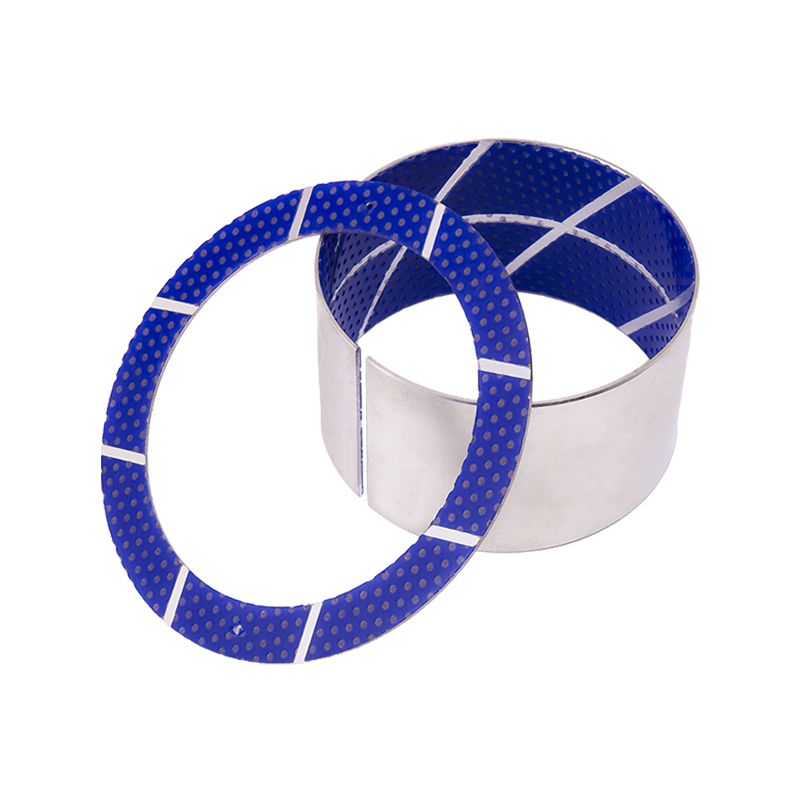
The structural composition of HZ20 series boundary lubrication bearings follows a precise three-layer architecture. The foundation is a steel plate backing, which provides the structural rigidity and dimensional stability required to maintain consistent bore geometry under the mechanical loads and thermal cycling typical of industrial equipment. Steel backing also enables secure press-fit installation into housings, ensuring the bearing does not rotate relative to its bore — a failure mode common in softer backing materials under high load. Sintered onto the steel backing is a layer of spherical bronze powder condensed in the middle of the composite structure, creating a porous metallic matrix with a high specific surface area. This bronze interlayer provides the mechanical bonding interface between the steel base and the polymer surface layer, while its interconnected porosity serves as a reservoir for lubricant retention within the bearing body itself.
The running surface of HZ-20 boundary lubricated bearings is formed by modified polyoxymethylene (POM) rolled on the surface of the sintered bronze layer. POM — commonly known by trade names such as Delrin or Hostaform — is a high-crystallinity engineering thermoplastic with an exceptionally low coefficient of friction, excellent dimensional stability, and very high compressive strength relative to other bearing-grade polymers. The modification applied to the POM compound in HZ-20 bearings typically involves the addition of lubricant additives such as PTFE or MoS₂, which further reduce the surface friction coefficient and improve wear resistance under boundary and mixed lubrication conditions. Machined into the POM running surface are oil storage pits — shallow recesses distributed across the bearing bore that act as micro-reservoirs, capturing and retaining lubricant applied during maintenance and releasing it gradually to the contact zone during operation.
Key Technical Parameters and Operating Conditions
Selecting HZ-20 boundary lubricated bearings for a specific application requires a clear understanding of the operating envelope within which this bearing type performs reliably. The HZ20 series is specifically engineered for low-speed and medium-load conditions under normal temperature environments — a specification range that encompasses a very large proportion of industrial plain bearing applications but that also defines the boundaries beyond which alternative bearing solutions should be considered.
| Parameter | HZ-20 Typical Range | Notes |
|---|---|---|
| Max Static Load (P) | ≤ 250 N/mm² | POM surface compressive strength limit |
| Max Sliding Speed (V) | ≤ 0.5 m/s | Low-speed regime for boundary lubrication |
| Max PV Value | ≤ 0.1 N/mm²·m/s | Combined load-speed limit for thermal control |
| Operating Temperature | -40°C to +90°C | POM thermal stability range under load |
| Shaft Hardness Requirement | ≥ HRC 20 | Prevents shaft galling and accelerated wear |
| Shaft Surface Roughness | Ra 0.4–0.8 µm | Optimized for lubricant film retention |
The PV value — the product of bearing pressure and sliding velocity — is the most critical combined parameter governing heat generation at the contact interface. Exceeding the maximum PV rating causes the POM surface layer to soften and deform due to frictional heat accumulation, accelerating wear and eventually compromising dimensional integrity. Within the specified PV envelope, however, HZ-20 boundary lubricated bearings demonstrate stable wear rates and predictable service life that allows maintenance intervals to be planned with confidence.
How HZ-20 Bearings Replace Traditional Copper Sleeves and Reduce Costs
One of the most commercially significant capabilities of HZ-20 boundary lubricated bearings is their ability to directly replace traditional copper sleeves in a wide range of plain bearing applications, delivering both cost reductions and performance improvements that make the transition economically compelling. Understanding why this substitution works — and where it delivers the greatest benefit — requires a direct comparison of how copper sleeves and HZ-20 composite bearings perform across several key service parameters.
Material Cost and Supply Chain Advantages
Copper and copper alloys — particularly leaded bronze, which has historically been the dominant material for plain bearing sleeves — carry a significant material cost premium driven by copper commodity pricing and the increasingly restricted availability of lead-containing alloys under environmental regulations in major industrial markets. HZ-20 boundary lubricated bearings use steel as their primary structural material, with copper present only in the thin sintered bronze interlayer, dramatically reducing the metal content cost per bearing. The POM surface layer adds minimal material cost while delivering superior tribological performance to the bearing contact surface. For manufacturers purchasing bearings in volume, the substitution of copper sleeves with HZ-20 composite bearings can reduce per-unit material costs by 30–50% depending on bearing size and the copper alloy grade being replaced.
Extended Service Life Through Superior Wear Performance
Beyond initial purchase price, the more significant economic argument for replacing traditional copper sleeves with HZ-20 boundary lubricated bearings lies in their ability to extend service life under boundary lubrication conditions — precisely the operating regime in which many copper sleeve installations function in practice. Plain bronze bushes in slow-moving, heavily loaded mechanisms frequently operate without a full fluid film because shaft speeds are too low to generate hydrodynamic pressure. In this boundary regime, the bronze surface is in intermittent direct contact with the shaft, and wear rate is governed by the hardness and friction characteristics of the bronze alloy. The modified POM surface of HZ-20 bearings offers a lower friction coefficient than bronze against steel, combined with the lubricant retention provided by the oil storage pits, which continuously replenish the contact zone with lubricant and reduce the frequency and severity of dry contact events that cause accelerated wear.
Rolling Mill Applications: Saving Refueling Frequency and Simplifying Maintenance
Rolling mills represent one of the most demanding and highest-value application environments for HZ-20 boundary lubricated bearings, and the specific operational benefits in this context illustrate the bearing's design advantages in concrete terms. Rolling mill equipment — used in steel, aluminum, copper, and paper industries — subjects its plain bearings to high loads, frequent oscillating motion, contaminated environments, and maintenance access constraints that make conventional lubrication-intensive bearing solutions both unreliable and operationally burdensome.
The use of HZ-20 boundary lubricated bearings on rolling mills can save refueling frequency significantly compared to conventional copper sleeve or bronze bushing installations that depend on externally supplied grease or oil to maintain an adequate lubricant film. The oil storage pits machined into the POM running surface of HZ-20 bearings function as an integrated micro-lubrication system — they capture lubricant applied during periodic maintenance and meter it gradually into the contact zone over an extended operating period. This reduces the frequency of lubrication interventions required to maintain acceptable bearing performance, which is particularly valuable in rolling mill environments where access to bearing locations may require production stoppages and where re-lubrication procedures add labor cost and downtime.
The ability to simplify replacement procedures is an equally important operational benefit in rolling mill service. HZ-20 boundary lubricated bearings are dimensionally standardized to replace common copper sleeve sizes, meaning that housings and shafts do not require modification for the transition. The press-fit installation procedure is identical to that used for copper sleeves, and the composite bearing's steel backing provides the interference fit retention force required to prevent bearing rotation in the housing even under the high torque loads typical of rolling mill operation. When worn bearings require replacement, the procedure is straightforward and can be completed with standard workshop tooling by maintenance technicians already familiar with plain bearing replacement — no specialized skills or equipment are needed beyond what the copper sleeve replacement process already required.
Installation Guidelines and Maintenance Best Practices
Realizing the full service life potential of HZ-20 boundary lubricated bearings requires correct installation practice and an appropriate maintenance regime. The following guidelines cover the most critical factors that determine whether the bearing performs to specification throughout its intended service period.
- Housing bore preparation: The housing bore must be machined to the recommended tolerance class (typically H7) to achieve the correct interference fit with the bearing's steel outer diameter. Undersized bores create excessive press-fit stress that can distort the bearing bore; oversized bores allow bearing rotation under load.
- Press-fit installation: Apply uniform axial press force across the full bearing end face using a press tool that matches the bearing outer diameter. Never hammer directly on the bearing face or apply force only to one side, as this causes bore distortion and misalignment of the POM running surface.
- Initial lubrication: Apply a thin film of the specified lubricant — light machine oil or grease compatible with POM — to the bearing bore and shaft surface at initial assembly. This primes the oil storage pits and ensures the contact zone is lubricated from the first moments of operation before a normal service lubrication cycle is established.
- Periodic re-lubrication intervals: Under normal operating conditions, re-lubrication intervals of 500–1,000 operating hours are typical for HZ-20 boundary lubricated bearings, depending on load intensity and environmental contamination levels. Harsh environments with abrasive contamination require shorter intervals to flush wear debris from the contact zone.
- Wear monitoring: Periodically check shaft-to-bearing diametral clearance during scheduled maintenance. When clearance has increased to approximately twice the original installation clearance, bearing replacement should be planned to prevent accelerated shaft wear from developing.
Consistent application of these practices ensures that HZ-20 boundary lubricated bearings deliver their designed service life advantage over traditional copper sleeves, validating the economic case for their adoption across the full range of low-speed, medium-load industrial plain bearing applications for which they are specifically engineered.