English
 русский
 Español
 عربى
عربى
Sliding bearings have been friction management tools in mechanical systems for centuries, but the copper sleeve bearing in its modern form—rolled from precision-drawn bronze strip, machined with engineered oil pockets, and sized to micron tolerances—is a fundamentally different product from the cast bronze bushings that preceded it. Understanding that difference is the starting point for anyone evaluating copper sleeve bearings for agricultural machinery, construction equipment, or industrial drivetrains.
Content
- 1 What Is a Copper Sleeve Bearing?
- 2 Rolled vs Cast: Why the Manufacturing Method Matters
- 3 Oil Groove and Oil Pocket Design: The Lubrication Architecture
- 4 Material Selection: Tin Bronze, Brass, and Alloy Trade-Offs
- 5 Application Environments: Where Copper Sleeve Bearings Perform Best
- 6 Flanged vs Plain Cylindrical: Choosing the Right Bearing Form
- 7 Installation Guidelines for Long Service Life
What Is a Copper Sleeve Bearing?
A copper sleeve bearing is a plain bearing—meaning it creates a sliding contact surface between a rotating or oscillating shaft and its housing—made from a copper alloy, typically tin bronze (CuSn8 or CuSn6) or brass. Unlike rolling-element bearings that use balls or rollers, sleeve bearings transfer load across a cylindrical contact area, which distributes stress broadly and makes them particularly well suited to heavy radial loads at low to moderate speeds.
The bearing takes its name from its geometry: a hollow cylinder, or sleeve, that fits tightly into a housing bore and presents a lubricated inner surface to the shaft. Oil or grease stored in pockets machined into the inner diameter maintains a separating film between shaft and bearing during operation, preventing direct metal-to-metal contact and controlling wear.
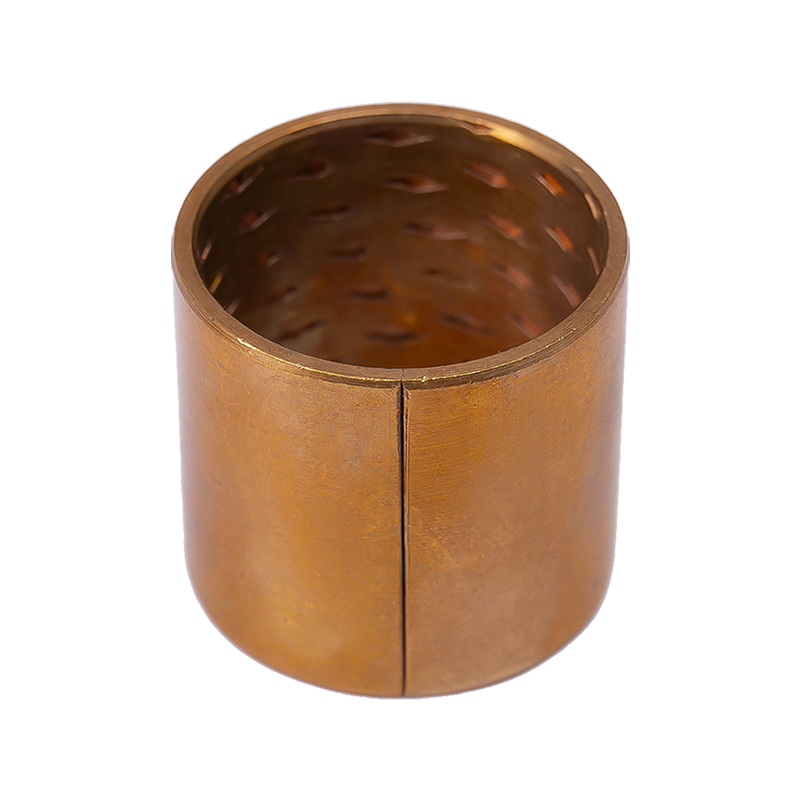
The HZ090 single metal copper sleeve series represents the current generation of rolled copper sleeve bearings—manufactured from high-density copper alloy strip rather than cast billets, which eliminates the shrinkage voids and density variations inherent in casting and results in a more uniform, fatigue-resistant bearing structure.
Rolled vs Cast: Why the Manufacturing Method Matters
Two distinct manufacturing routes produce copper sleeve bearings, and the choice between them affects performance in ways that are not always obvious from a product drawing alone.
Cast copper sleeve bearings are poured from molten alloy into a mold—either sand cast, centrifugally cast, or continuously cast into billets that are then machined to final dimensions. Casting is well established and can produce thick-walled, complex shapes. The limitation is microstructure: solidification introduces porosity (shrinkage voids) and segregation of alloying elements, both of which create local weak points in a material that will be subjected to cyclic contact stresses.
Rolled (wrapped) copper sleeve bearings start as flat strip—hot-rolled and homogenized at the mill—which is then cold-formed over a precision mandrel into a cylindrical sleeve. The wrapping process work-hardens the surface slightly and preserves the uniform, dense grain structure of the strip. There are no shrinkage voids because no metal is ever liquid during bearing fabrication. The result is a bearing with higher density, greater fatigue resistance under impact loading, and more consistent dimensional tolerances than an equivalent cast part.
For applications in agricultural machinery—where shock loads from uneven ground, abrasive contaminants, and extended lubrication intervals are normal operating conditions—the structural advantages of the rolled approach translate directly into longer service life.
Oil Groove and Oil Pocket Design: The Lubrication Architecture
The inner surface geometry of a copper sleeve bearing is not merely a smooth bore. The friction surface carries an engineered pattern of oil holes, oil pits, or oil grooves whose design determines how effectively the bearing stores and releases lubricant during operation.
Three configurations appear most frequently in production bearings:
- Helical oil groove: A continuous spiral groove machined into the inner bore distributes grease or oil evenly across the bearing length during rotation. It is the standard configuration for bearings that are regularly re-lubricated through a grease fitting, as the groove channels fresh grease from the fitting port to the full bearing surface.
- Diamond-shaped oil pockets (indentations): Shallow diamond or rhombus-shaped indentations pressed or machined into the inner surface create a pattern of discrete lubricant reservoirs across the entire contact area. The indentations fill with grease at assembly; during operation they release lubricant gradually as the shaft passes over each pocket, creating a near-continuous film. This configuration is preferred for sealed or difficult-to-access applications where re-lubrication intervals must be extended.
- Cylindrical oil holes: Through-holes drilled radially through the bearing wall allow lubricant to be injected directly to the shaft surface from an external grease fitting in the housing. This is common in heavy-duty construction machinery where high-pressure grease injection is the maintenance standard.
The practical benefit of the indentation pattern, in particular, is significant. Compared to a plain bore bearing that relies solely on applied grease at assembly, a bearing with diamond oil pockets can extend the lubrication interval by several times—a measurable advantage in agricultural equipment that operates seasonally and may go weeks without maintenance attention. HZ090 tin bronze oil groove copper bushings combine precisely machined oil grooves with the high-density rolled strip matrix, giving each reservoir maximum depth without compromising wall strength.
Material Selection: Tin Bronze, Brass, and Alloy Trade-Offs
Copper sleeve bearings are produced from several distinct alloy families, each optimized for a different combination of load, speed, environment, and cost:
Tin bronze (CuSn8, CuSn6): The dominant alloy for industrial and agricultural sleeve bearings. The 8% tin content provides a combination of high yield strength, good anti-friction properties against steel shafts, and natural corrosion resistance. CuSn8 is specified under DIN 1494 / ISO 3547 for wrapped bushings precisely because its homogeneous strip form gives consistent mechanical properties batch to batch. Operating temperature range is typically –40°C to +150°C, with dynamic load capacity around 40 N/mm².
Brass (CuZn): Lower cost than tin bronze, with adequate strength for lighter loads and moderate speeds. Brass sleeve bearings appear in HZ092 brass oil groove copper bushing configurations where cost sensitivity is primary and operating loads are moderate. Brass machines freely, which facilitates precise oil groove geometry, but its fatigue strength under impact loading is lower than tin bronze.
Leaded bronze (CuSn + Pb): Lead additions improve the self-lubricating characteristics of the alloy and make it more forgiving on rough or out-of-round shaft surfaces. Used historically in applications where shaft finish is difficult to control, though lead-free alternatives are increasingly specified in response to environmental regulations in key export markets.
For most new designs in agricultural and construction machinery, CuSn8 rolled strip is the correct starting point: its balance of strength, lubricity, machinability, and supply consistency is hard to match with other alloy families.
Application Environments: Where Copper Sleeve Bearings Perform Best
Copper sleeve bearings occupy a specific performance niche that is worth defining precisely, because they outperform other bearing types in some conditions and are the wrong choice in others.
Optimal conditions for copper sleeve bearings:
- Heavy radial loads at low to medium shaft speeds (oscillating, reciprocating, or slow rotary motion)
- Applications with shock or impact loading—construction machinery pivot pins, excavator linkage joints, tractor hitch pins—where rolling-element bearings would fail prematurely from Brinell damage to the raceways
- Dirty or contaminated environments where sealed rolling bearings are difficult to protect and sleeve bearings' simple geometry is easier to seal
- Space-constrained installations where the thin-wall construction of a rolled sleeve bearing occupies significantly less radial space than an equivalent ball or roller bearing
- Cost-sensitive high-volume applications in agricultural machinery—seed drill couplings, harvester straw-walker shafts, baler plunger guides—where the per-unit cost of a bronze sleeve is a fraction of an equivalent rolling bearing
Conditions where rolling bearings are preferable: High rotational speeds, precision positioning requirements, very low friction losses under light load, or applications where predictive maintenance based on vibration signature is required.
The agricultural machinery sector is the clearest example of copper sleeve bearing strength: tractors, harvesters, and tillage equipment operate at low pivot speeds, encounter constant soil contamination, and require components that can survive a season without specialist maintenance. HZ090 series copper sleeve bearings are specifically engineered for these conditions, with oil pocket geometry calibrated for extended grease intervals and wall thickness sized for the high specific loads typical of implement hitch and linkage joints.
Flanged vs Plain Cylindrical: Choosing the Right Bearing Form
Copper sleeve bearings are produced in two primary geometric forms that address different installation requirements:
Plain cylindrical sleeves are the basic form—a straight tube pressed into a housing bore with the shaft running through the inner diameter. They carry radial load only and rely on external retaining features (circlips, end caps, or interference fit) to prevent axial migration. They are the lightest and most compact option and are used wherever axial forces are absent or managed by other means.
Flanged bushings add an integral collar at one or both ends of the cylindrical section. The flange provides a bearing surface for axial (thrust) loads and simultaneously locates the bearing axially in the housing without additional retaining hardware. For oscillating pivot joints in machinery—where the joint axis reverses direction and small axial forces arise at each reversal—a flanged bushing eliminates the separate thrust washer and simplifies assembly.
The HZ090F diamond-shaped oil groove flanged bronze bushing combines both the radial and axial bearing function in a single rolled component, with the oil pocket pattern applied to both the bore surface and the flange face for full lubrication coverage of both load directions.
Installation Guidelines for Long Service Life
The performance advantage of a high-quality copper sleeve bearing can be negated by poor installation practice. Three rules govern reliable results:
Press-fit, not hammer-fit. Copper sleeve bearings are designed for interference-fit installation: the bearing outer diameter is slightly larger than the housing bore, and pressing the bearing in with a parallel arbor press creates the interference that locks the bearing in place and transfers load to the housing. Hammering a sleeve bearing into a housing deforms the bore, closes up the oil grooves, and changes the inner diameter—often making the installed clearance inadequate for the shaft. Use a properly sized mandrel and a press.
Pre-fill oil pockets before sealing. Diamond oil pockets and oil holes are only useful if they contain lubricant at start-up. Pack grease into every pocket on the inner diameter before installing the shaft. The grease displaced by the shaft as it enters the bore will distribute itself, but pre-filling ensures the bearing is lubricated from the first cycle of operation, not after the initial dry-running period wears the surface.
Verify shaft finish and hardness. Copper sleeve bearings perform best against shafts hardened to HRC 50–60 with a surface finish of Ra 0.4–0.8 µm. Softer shafts wear preferentially and contaminate the bearing with metallic debris; rougher surfaces accelerate bearing wear. If shaft replacement is not possible, selecting a softer, more conformable bearing alloy (leaded bronze) mitigates the effect of poor shaft condition.
For guidance on matching bearing type to specific machinery requirements, reviewing the full range of plain bearing and bushing product lines available across different alloy systems helps identify whether a copper sleeve, a bimetal composite bearing, or a self-lubricating alternative is the right engineering answer for each application.