English
 русский
 Español
 عربى
عربى
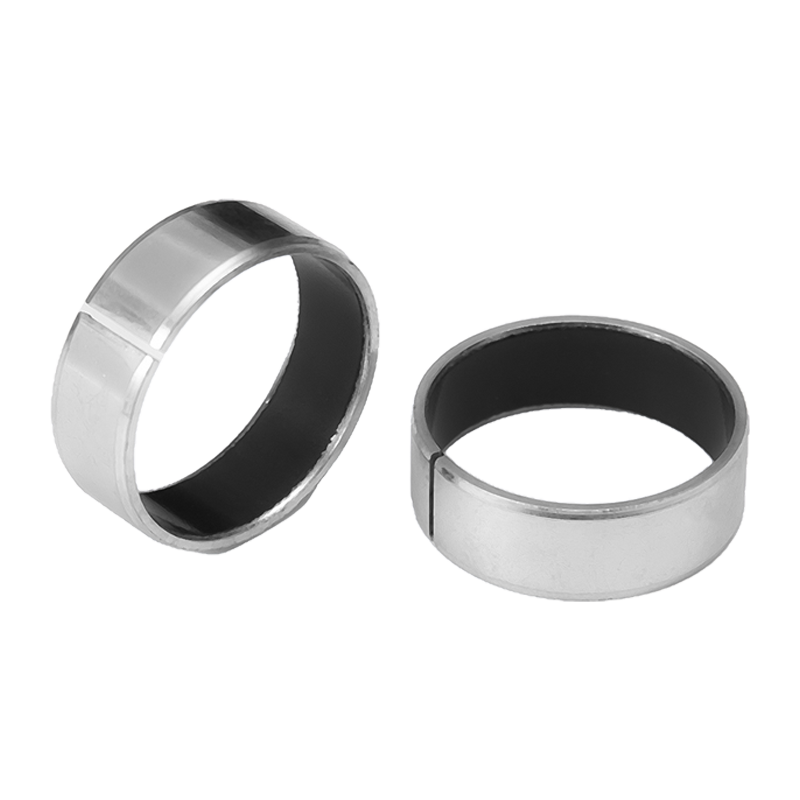
Most engineers searching for a bearing that requires no lubrication schedule, generates minimal friction, and runs quietly under continuous load will eventually arrive at the same material architecture: a steel backing, a sintered bronze intermediate layer, and a PTFE-based surface compound. This three-layer structure — known variously as a PTFE composite bearing, steel-backed PTFE bushing, or self-lubricating plain bearing — is the standard solution for sliding applications where grease ports are impractical and rolling element bearings are oversized for the task.
Understanding what makes this structure work, and where each variant fits, is the foundation of any competent bearing selection decision.
Content
The Three-Layer Structure: How a PTFE Composite Bearing Works
A PTFE composite bearing is not simply a plastic bushing. It is an engineered laminate in which each layer performs a distinct mechanical role, and the performance of the finished bearing depends on all three working together.
The outer backing layer is high-quality low-carbon steel. Steel provides the compressive strength that PTFE alone cannot — the backing transmits load from the housing into the bearing structure, prevents deformation under high contact pressure, and gives the bearing the dimensional stability needed for precise bore tolerances. Without this backing, the PTFE layer would creep and extrude under load.
The intermediate layer is sintered spherical bronze powder, bonded to the steel face and extending partially into the PTFE compound above it. This porous bronze matrix serves two functions: it creates a mechanical interlock that anchors the surface layer against peeling or delamination, and its thermal conductivity helps dissipate frictional heat away from the sliding interface. The bronze layer also provides a reserve of structural support if the thin PTFE surface layer wears through in localized areas.
The surface layer is a rolled mixture of PTFE (polytetrafluoroethylene) and lead. PTFE has one of the lowest friction coefficients of any known solid — typically 0.04–0.20 depending on load and speed — and transfers a thin lubricating film to the shaft surface during running-in. Lead acts as a soft filler that improves the layer's resistance to cold flow under compressive load and extends wear life. The result is a surface that lubricates itself continuously from within the material, with no external oil or grease required.
The usable temperature range of a well-made steel-backed PTFE bushing spans approximately −200°C to +280°C, making it functional in cryogenic applications and in continuous-duty equipment exposed to process heat. Under high-load, low-speed conditions — the operating regime most common in oscillating linkages, press tooling, and agricultural machinery pivot points — friction coefficient values below 0.05 are achievable.
Steel-Backed PTFE Bushing vs Other Self-Lubricating Plain Bearing Types
Self-lubricating plain bearings cover a broader family than PTFE composite alone. Understanding where each type fits prevents misapplication.
Sintered bronze (Oilite-type) bearings use oil stored in a porous copper matrix, released by thermal expansion during operation and reabsorbed when the shaft stops. They suit moderate speeds and loads in clean environments but perform poorly in contaminated or washdown conditions where ingested debris blocks the pores. They also have a finite oil reservoir that depletes over time.
Graphite-plugged bronze bearings use embedded solid graphite as a dry lubricant. They excel at extreme temperatures — above 250°C where PTFE would begin to lose mechanical stability — and under very heavy static or slow-cycling loads. They are the correct choice for industrial kiln conveyors, furnace equipment, and high-temperature press mechanisms.
Steel-backed PTFE composite bearings occupy the broadest general-purpose position: dry running, no contamination risk, wide temperature range, low noise, and good wear life across oscillating, rotating, and reciprocating motion profiles. Their thin-wall construction — typically 1.0–2.5 mm total thickness — allows them to fit into shaft/housing combinations where a bulkier rolling element bearing would require redesigning the surrounding structure.
Huazhou's HZ-10 self-lubricating bearing series is built on exactly this three-layer PTFE composite architecture, available with steel, copper, or stainless steel backing depending on the corrosion resistance and structural requirements of the application. The stainless steel-backed variant (HZ1S) adds resistance to acids, alkalis, and seawater — extending the design's reach into marine, chemical processing, and food equipment environments.
Where Self-Lubricating Plain Bearings Perform Best
The applications where PTFE composite bearings consistently outperform alternatives share a common set of constraints: maintenance access is limited, contamination would rule out grease, or space constraints rule out rolling bearings.
Automotive suspension and steering linkages are the most established application. PTFE-lined spherical plain bearings in suspension arms, tie rod ends, and stabilizer bar links handle angular misalignment, oscillating motion, and road-induced shock loads without requiring greasing over the vehicle's service life. The combination of low friction and high damping from the plain contact geometry reduces NVH (noise, vibration, harshness) relative to rolling element alternatives.
Agricultural and construction equipment pivot points — loader arms, bucket hinges, blade linkages — operate in abrasive mud and grit. Bronze-backed or sintered-interlayer PTFE bearings tolerate these conditions better than greased needle bearings, whose seals fail quickly under grit ingression. The thick contact area of a plain bearing also distributes shock loads across a larger surface than the line contacts of a roller bearing.
Packaging and textile machinery demand low noise and precise, repeatable motion at moderate speeds. Grease contamination of product is unacceptable. PTFE composite bushings run silently and cleanly, making them standard in cam followers, guide rails, and feed mechanism pivots across these industries.
New energy and electric vehicle systems represent an expanding application domain. Huazhou's HZ1E variant — using an inorganic white filler in place of lead — is specifically developed for EV applications where lead-free material compliance is required, while maintaining the low friction coefficient and running-in performance of the standard PTFE-lead compound.
For applications requiring axial load management alongside radial bearing function, the PTFE composite thrust washer uses the same three-layer construction in a flat form factor, and the flanged self-lubricating bearing integrates radial and thrust surfaces in a single component.
Selection Parameters: What Buyers Need to Specify
Selecting the correct PTFE composite bearing for a given application requires four inputs: load, speed, temperature, and environment. These determine whether the standard steel-backed PTFE-lead structure is sufficient, or whether a variant — stainless backing, lead-free filler, copper base for higher load capacity — is needed.
The key performance limit for this bearing type is PV rating: the product of contact pressure (P, in MPa) and sliding velocity (V, in m/s). For a standard steel-backed PTFE-lead composite, the continuous PV limit is approximately 0.05–0.10 MPa·m/s in dry running, rising to 0.5 MPa·m/s with intermittent lubrication. Sliding speeds should generally remain below 2 m/s to avoid excessive frictional heating that accelerates PTFE wear.
For oscillating and slow-rotating applications — the majority of the HZ-1 series' target use cases — these limits are rarely the binding constraint. The more common design challenge is bore tolerance: PTFE composite bushings are pressed into the housing bore and rely on interference fit for retention, so the housing bore diameter, surface finish, and chamfer geometry must be within the manufacturer's installation specification to avoid the bushing rotating in the housing under load.
Zhejiang Huazhou Technology Co., Ltd. manufactures the full HZ-10 series range from its facility in Nanxun, Zhejiang, with more than 280 specialist machines and 50 automated production lines supporting daily output capacity. The product range extends beyond PTFE composite to include bimetal composite bearings for higher load applications, graphite copper sleeves for extreme-temperature environments, and engineering plastic bearings for lightweight, corrosion-resistant requirements.
For technical consultation and sample requests, contact Zhejiang Huazhou Technology at the company's contact page or directly at +86-18957305868.